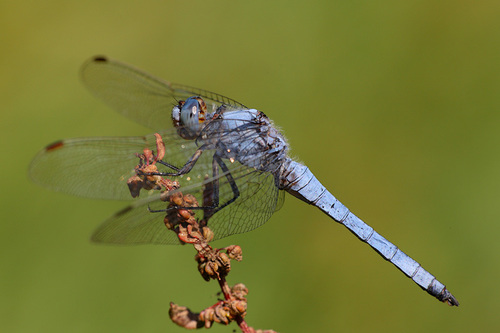
Southern Skimmer
Orthetrum brunneum
A master of the summer heat, the Southern Skimmer is easily identified by the striking, uniform powder-blue coat of the mature male. This territorial sentinel is a common sight around sunny garden ponds, where it defends its domain with unmatched aerial agility.
Quick Identification
Size
Length: 40-45 mm (1.6-1.8 in); Wingspan: 65-70 mm (2.5-2.8 in)
Colors
Mature males are entirely powder-blue (pruinose) including the face; females and juveniles are ochre-yellow to olive-brown with two dark longitudinal lines on the abdomen.
Key Features
- Uniform powder-blue body in mature males
- Light blue or whitish face (males)
- No black tip on the abdomen
- Clear wings with small yellowish-brown pterostigma (wing spots)
When You’ll See Them
Behavior
The Southern Skimmer is a sun-loving, highly territorial dragonfly that spends much of its day patrolling the edges of shallow water. Males are particularly known for their 'perch and patrol' strategy, where they claim a specific stick, stone, or patch of bare earth as their own. They will aggressively chase off any competing males or other large insects that enter their airspace, almost always returning to the exact same perch once the intruder has been banished.
Unlike many other dragonflies that prefer to cling to tall reeds or grasses, the Southern Skimmer has a peculiar habit of perching low to the ground or on flat, sun-warmed surfaces. This behavior is partly to regulate their body temperature and partly to get a clear view of any prey flying overhead. They are exceptionally fast flyers but are generally less wary of humans than other skimmers, often allowing for close observation if approached without sudden movements.
EverydayEarth exclusive
Camera Tips
Capturing the Southern Skimmer on a backyard camera is all about identifying their favorite perches. Look for flat rocks, bare patches of soil, or low-lying sticks near the edge of a pond that receive direct sunlight for most of the day. Because this species is highly territorial and predictable, if you see one landing on a specific spot, there is a very high probability it will return to that exact same location within minutes. Position your camera on a tripod or mount at a low angle (6-12 inches off the ground) to get an eye-level perspective of the dragonfly.
Lighting is your best friend and your worst enemy with this species. The 'pruinescence'—the waxy blue powder on the male's body—can easily reflect harsh midday sun and result in a 'blown out' white appearance in photos. To combat this, set your camera's exposure compensation to -0.3 or -0.7. If your camera allows for macro settings or has a close-focus lens, use it; these dragonflies are small, and you want to fill the frame to capture the intricate wing venation and the subtle blue of the face.
For those using motion-activated trail cameras, the Southern Skimmer might be too small to trigger standard PIR sensors. Instead, use a camera with a 'time-lapse' mode set to take a photo every 30 seconds during the peak hours of 11 AM to 2 PM. Alternatively, you can 'bait' a specific area by placing a dry, attractive branch at a 45-degree angle over the water's edge. Ensure the background is as far away as possible to create a beautiful blurred effect (bokeh) that makes the powder-blue body of the skimmer pop against the greenery.
Similar Species
Species that look similar or are commonly confused with Southern Skimmer.
Black-tailed Skimmer
The Black-tailed Skimmer has a distinct black tip on its abdomen and a dark face, whereas the Southern Skimmer is blue throughout.
Keeled Skimmer
Smaller and slimmer than the Southern Skimmer, the Keeled Skimmer has a brownish face and more yellowish-brown wing spots (pterostigma).
Frequently Asked Questions
Record Southern Skimmer at your habitat
Connect a camera to start building your own species record — AI identifies every visitor automatically.