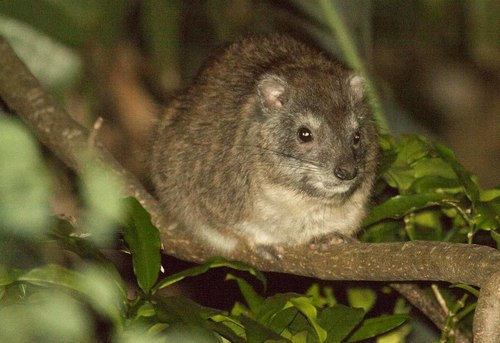
Southern Tree Hyrax
Dendrohyrax arboreus
Meet the elephant's tiny cousin that lives in the clouds. The Southern Tree Hyrax is a nocturnal acrobat, turning the African canopy into its personal playground while filling the night with its unmistakable, haunting calls.
Quick Identification
Size
Length: 45–70 cm (18–28 in); Weight: 1.5–4.5 kg (3.3–10 lbs)
Colors
Thick, soft grayish-brown fur with a prominent white or cream-colored patch of hair on the lower back covering a scent gland; pale grey to white underbelly.
Key Features
- Small, stocky build resembling a large guinea pig
- Distinctive white or cream-colored patch of hair on the mid-back
- Short, rounded ears with hair inside
- Specialized three-toed feet with flat, nail-like hooves and rubbery pads
When You’ll See Them
Behavior
Despite their somewhat clumsy appearance, they are incredibly agile climbers. They possess specialized, moist pads on the soles of their feet that create a suction-like grip, allowing them to scale smooth bark and steep branches with ease. While they are primarily arboreal, they will occasionally descend to the ground to move between trees, though they remain extremely cautious and quick to retreat at the slightest sign of danger.
EverydayEarth exclusive
Camera Tips
Because they are strictly nocturnal, a 'No-Glow' infrared flash is essential. Standard 'Low-Glow' LEDs produce a faint red light that can spook these shy mammals, causing them to alter their routes or stay hidden. Set your camera to record video clips (15-20 seconds) rather than just stills. Their movements are fascinating, and because they often sit still for long periods while feeding, a single photo might miss the action or look like a mossy knot on a branch.
If you are setting a camera in a backyard or suburban garden, focus on mature indigenous trees like the Yellowwood or Cape Fig. They are creatures of habit and will often use the same 'branch highway' every night. Avoid using food bait, as they are very selective eaters; instead, focus on placement near their natural travel routes. Check your camera every few weeks, but try to minimize your scent profile near the tree, as they have a keen sense of smell and may avoid the area if it feels high-traffic.
Similar Species
Species that look similar or are commonly confused with Southern Tree Hyrax.
Frequently Asked Questions
Record Southern Tree Hyrax at your habitat
Connect a camera to start building your own species record — AI identifies every visitor automatically.