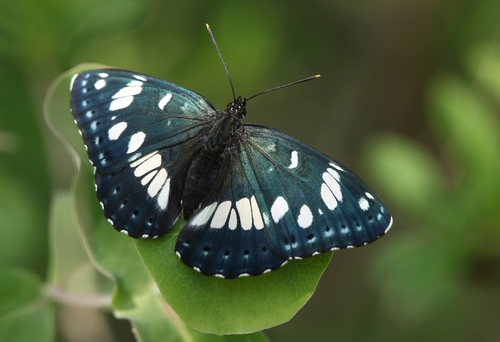
Southern White Admiral
Limenitis reducta
An elegant master of the woodland edge, the Southern White Admiral dazzles with its velvet-black wings and flashes of electric blue. Watching its graceful glide through sun-dappled glades is a highlight for any backyard naturalist.
Quick Identification
Size
Wingspan of 45–55 mm (1.8–2.2 inches)
Colors
Velvety black or dark blue-black upper wings with a striking white band and a brilliant blue iridescence in sunlight. The underside is orange-brown with white markings and a single row of black spots.
Key Features
- Striking white band across both wings
- Brilliant blue iridescence on dark upper wings in direct sunlight
- Single row of black spots on the white band of the hindwing underside
- Elegant gliding flight pattern with infrequent wing beats
- Antennae with orange-tipped clubs
When You’ll See Them
Geographic range
Where Does the Southern White Admiral Live?
This striking butterfly is a native of Southern Europe and the Mediterranean basin, extending its reach into parts of Central Europe, North Africa, and Western Asia. Its core populations thrive in the warm, sun-soaked regions of France, Italy, Spain, and the Balkans, stretching eastward through Turkey and into Iran. While it favors the warmer Mediterranean climates, it remains a localized resident across much of the Palearctic realm where its host plants are found in abundance.
Basemap © OpenStreetMap contributors
Behavior
The Southern White Admiral is celebrated for its graceful, gliding flight pattern, alternating between quick wing beats and long, elegant sails through sunlit woodland clearings. Males are particularly territorial, often selecting a prominent "throne" on a sun-drenched leaf or branch where they can survey their domain. From these vantage points, they aggressively intercept passing butterflies to defend their space or pursue potential mates.
Unlike many common garden butterflies that prefer wide-open flower beds, this species is a specialist of the woodland edge. They are frequently seen patrolling forest paths or resting on low-hanging foliage at the periphery of woods. While they do visit flowers for nectar, they are also highly attracted to "honeydew"—the sugary secretions left behind by aphids—and can sometimes be found sipping moisture from damp earth or extracting minerals from animal droppings on the forest floor.
EverydayEarth exclusive
Camera Tips
To capture the Southern White Admiral on a backyard or trail camera, focus on "flyways" rather than just flowers. These butterflies have predictable patrol routes along woodland edges or garden boundaries. Position your camera about 1 to 1.5 meters off the ground, angled slightly downward toward a prominent, sun-lit leaf or a patch of flowering bramble. Because they are fast-moving gliders, use a camera with a high trigger speed (under 0.2 seconds) or set it to record short 10-second video clips to capture their unique flight mechanics.
Baiting can be highly effective for this species, as they are often more interested in minerals and sugars than traditional nectar. You can create a "butterfly bar" by smearing a fermented fruit mash—made of overripe bananas, brown sugar, and a splash of beer—onto a tree trunk or a flat wooden platform within the camera's view. They are also attracted to damp patches of soil, a behavior known as "puddling." Maintaining a small, muddy area enriched with a pinch of sea salt can lure them down from the canopy during the hottest parts of the day for a perfect close-up.
Timing and lighting are critical for the best photographic results. These butterflies are most active in full sun, typically between late morning and mid-afternoon. Ensure your camera is positioned so the sun is behind the lens; this backlighting or direct light is the only way to highlight the incredible blue iridescence of their wings, which otherwise appears dull black. If you are using an AI-powered camera, set the sensitivity to high, as the graceful gliding flight can sometimes be subtle enough to avoid triggering standard motion sensors.
Similar Species
Species that look similar or are commonly confused with Southern White Admiral.
Frequently Asked Questions
Record Southern White Admiral at your habitat
Connect a camera to start building your own species record — AI identifies every visitor automatically.