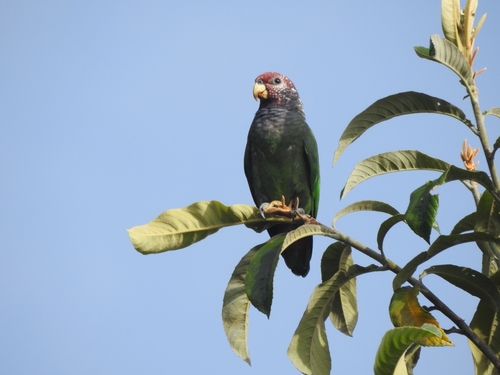
Speckle-faced Parrot
Pionus tumultuosus
Perched high in the misty Andean cloud forests, the Speckle-faced Parrot is a master of the canopy, adorned with a unique plum-colored crown and striking white speckles.
Quick Identification
Size
Approximately 27–30 cm (10.5–12 in) in length; weighing between 230–250 g (8.1–8.8 oz).
Colors
Deep green body with a rich plum or dark violet head; the face and crown are uniquely speckled with white or pale grey feathers. The undertail coverts feature the signature Pionus bright red.
Key Features
- Dark plum-colored head with distinct white speckling
- Bright red feathers on the undertail coverts
- Stocky, short-tailed silhouette in flight
- Pale yellowish-ivory bill
When You’ll See Them
Geographic range
Where Does the Speckle-faced Parrot Live?
The Speckle-faced Parrot is a resident of the South American Andes. Its native range is concentrated along the eastern slopes of the mountain range, stretching from central Peru through to northern Bolivia. These birds are true mountain specialists, rarely descending into the tropical lowlands, preferring the cool, humid air of the cloud forest belt.
Basemap © OpenStreetMap contributors
Behavior
The Speckle-faced Parrot is a social and vocal bird of the high Andes. They are most frequently observed in small, tight-knit flocks of 10 to 20 individuals, though larger gatherings may occur where food is abundant. They are known for their loud, rhythmic calling while in flight, which often gives away their presence long before they are seen through the thick mountain mist.
While they are active and energetic during their morning and evening commutes between roosting and feeding sites, they can become remarkably quiet and still once they begin foraging in the canopy. This 'stealth mode' helps them avoid predators, but makes them a challenge for birdwatchers to spot. In terms of human interaction, they are generally shy and wary, preferring the seclusion of primary montane forests over disturbed agricultural areas.
EverydayEarth exclusive
Camera Tips
To capture the Speckle-faced Parrot on camera, elevation is your most important factor. Because these birds rarely descend below 2,000 meters, your equipment must be positioned in high-altitude cloud forest environments. Look for 'corridors' or gaps in the canopy where flocks frequently fly through; placing a camera on a high ridge overlooking a valley can capture spectacular flight shots if the shutter speed is set high enough to freeze their rapid wingbeats.
For backyard or station-based setups in Andean communities, focus on fruiting trees rather than ground feeders. These parrots are strictly arboreal and will rarely come to the ground. Identifying a ripening Podocarpus tree or a highland fig and mounting your camera on a nearby sturdy limb—angled slightly downward to catch the bird as it reaches for fruit—is the most effective strategy. Using a camera with a fast trigger speed (0.2s or less) is vital, as they move quickly between branches.
Since these parrots inhabit humid, misty environments, ensure your camera housing is rated for high humidity and has a fresh desiccant pack inside. Lenses often fog up in the Andean morning dew, so a small 'overhang' or roof for your camera can help keep the glass clear. While they aren't typically attracted to standard birdseed, providing a source of clean water in a high-mounted basin or a mineral-rich clay lick (if natural ones aren't nearby) can act as a powerful lure for these shy birds.
Similar Species
Species that look similar or are commonly confused with Speckle-faced Parrot.
Frequently Asked Questions
Record Speckle-faced Parrot at your habitat
Connect a camera to start building your own species record — AI identifies every visitor automatically.