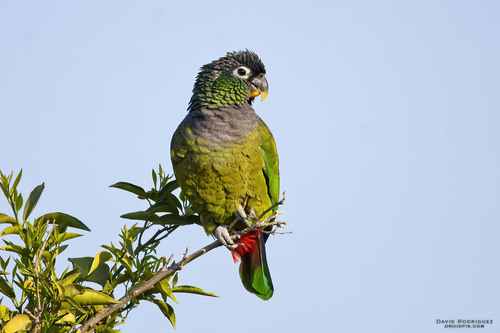
Scaly-headed Parrot
Pionus maximiliani
The Scaly-headed Parrot is a master of subtle beauty, featuring a sophisticated palette of bronze, olive, and purple. A resilient resident of South America's forests and suburbs, this intelligent 'Maximilian Pionus' is a favorite for backyard observers and birders alike.
Quick Identification
Size
29-30 cm (11.5-12 in) in length; weighs approximately 230-260g (8-9 oz)
Colors
Primarily bronze-green body with a distinct bluish-purple throat bib; head feathers are grey-bronze with dark edges creating a 'scaly' effect; bright red under-tail coverts.
Key Features
- Scalloped grey-bronze feathers on head and neck
- Vibrant red feathers under the base of the tail
- Square-ended tail and stocky build
- Dull olive-green wings and back
When You’ll See Them
Geographic range
Where Does the Scaly-headed Parrot Live?
Native to the heart of South America, the Scaly-headed Parrot enjoys one of the most extensive ranges of any Pionus species. It is found throughout eastern and central Brazil, stretching from the arid Caatinga through the lush Atlantic Forest, and extending westward into the lowlands of Bolivia. Its territory continues southward through the Chaco and Pantanal regions of Paraguay and reaches into the humid yungas and subtropical forests of northern Argentina.
Basemap © OpenStreetMap contributors
Behavior
The Scaly-headed Parrot is known for its relatively calm and 'thoughtful' demeanor compared to the more boisterous Amazon parrots. In the wild, they are social birds, usually seen in pairs or small family groups, though they may gather in larger flocks where food is abundant. They are distinctive for their direct, fast flight and a unique 'wheezing' sound they make when excited or startled.
While they can be shy around humans in remote areas, they have adapted remarkably well to suburban environments in South America. They are highly intelligent and spend much of their day foraging in the canopy, often hanging upside down to reach ripe fruits or seeds. They are creatures of habit, often using the same flight paths between roosting sites and feeding grounds every day.
EverydayEarth exclusive
Camera Tips
To capture the Scaly-headed Parrot on camera, height is your best friend. These are primarily canopy-dwelling birds, so mounting your AI-powered camera 6 to 10 feet off the ground will yield much better results than ground-level setups. Aim the camera at a sturdy, horizontal branch of a fruiting tree—citrus, guava, or palm trees are magnets for this species when the fruit is ripening.
Water is another excellent draw for these parrots, especially during the drier winter months. A high-platform bird bath or a hanging water basin will attract them for their daily morning drink. Position your camera to face north or south to avoid the harsh glare of the tropical sun, which can wash out the subtle bronze and purple tones of their plumage. Dappled shade provides the best lighting to highlight their 'scaly' head texture.
Because these birds are fast flyers, set your camera to a high shutter speed or a high-frame-rate video mode. They often land with a distinct tail-flare, which is the perfect moment to capture the brilliant red under-tail coverts that distinguish the Pionus genus. If you are using a trigger-based camera, ensure the sensitivity is high, as they can be surprisingly quiet when they land to feed.
Consistency is key. Scaly-headed Parrots follow strict daily routines. If you spot them in your area at 7:00 AM, they are likely to return at that exact time the next day. Use your camera's scheduling feature to focus on the early morning and late afternoon windows when they move between their roosts and feeding sites.
Similar Species
Species that look similar or are commonly confused with Scaly-headed Parrot.
Frequently Asked Questions
Record Scaly-headed Parrot at your habitat
Connect a camera to start building your own species record — AI identifies every visitor automatically.