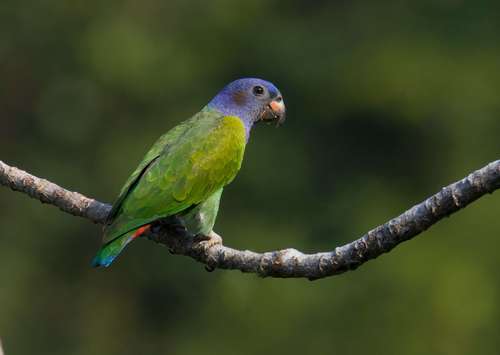
Blue-headed Parrot
Pionus menstruus
With its stunning cobalt-blue hood and vibrant emerald plumage, the Blue-headed Parrot is a crown jewel of the Neotropical canopy. Often heard before it is seen, this social and intelligent bird brings a burst of color to forest edges and tropical backyards alike.
Quick Identification
Size
Length 27–28 cm (11 in); Wingspan 52–56 cm (20–22 in); Weight 200–260 g (7–9 oz)
Colors
Bright emerald green body, cobalt blue head and neck, red undertail coverts, blackish ear patches, and a dark bill with a reddish base.
Key Features
- Cobalt blue head and neck contrasting with green body
- Bright red feathers under the base of the tail
- Dark gray or blackish 'ear' patch on the side of the head
- Stocky, short-tailed silhouette in flight
When You’ll See Them
Geographic range
Where Does the Blue-headed Parrot Live?
The Blue-headed Parrot is a quintessential Neotropical resident, native to the vast stretch of Central and South America. Its range begins in southern Costa Rica and Panama, extending across the northern coast through Colombia, Venezuela, and the island of Trinidad. To the south, it is widely distributed throughout the Amazon Basin, covering large portions of Ecuador, Peru, Bolivia, and Brazil, reaching as far south as the Mato Grosso region. While they are primarily lowland birds, they are resilient and can be found in a variety of wooded environments across these tropical and subtropical latitudes.
Basemap © OpenStreetMap contributors
Behavior
Blue-headed Parrots are highly social birds, frequently seen in pairs or small flocks of 10 to 30 individuals. While they spend much of their time foraging in the high canopy, they are loud and conspicuous in flight, emitting a series of high-pitched, screeching 'ke-ke-ke' calls that make them easy to locate before they are even seen. They are known for their intelligence and can be quite cautious, often freezing when they perceive a predator nearby.
In many parts of their range, these parrots participate in spectacular daily movements, flying from roosting sites to feeding grounds at dawn and returning at dusk. They are also famous for visiting 'clay licks' (collpas) along riverbanks, where they congregate by the hundreds to consume mineral-rich soil that helps neutralize toxins found in the wild seeds and unripe fruits they consume. While generally shy of humans in the deep forest, they have adapted to forest edges and rural gardens where food is plentiful.
EverydayEarth exclusive
Camera Tips
To capture the Blue-headed Parrot on an AI-powered camera, placement is everything. Since these are primarily arboreal birds, a camera mounted on a traditional tripod at ground level is unlikely to yield results. Instead, look for 'flight corridors'—natural gaps in the canopy or edges of forest clearings where the birds fly low. If you have a tall balcony or can safely mount a camera 10–15 feet high on a tree trunk overlooking a fruiting tree like a palm or a guava, you'll increase your chances of a clear shot significantly.
Luring these parrots requires patience and local knowledge. They are particularly attracted to water during dry spells, so a high-altitude birdbath or a dripping water feature on a raised platform can be a magnet. In rural or suburban backyard settings, they may be attracted to feeding stations stocked with sunflower seeds, corn on the cob, or tropical fruits like papaya and banana. However, be aware that they are often wary of new objects, so it may take several weeks for them to trust a new feeder enough to land in front of a camera.
Because parrots are fast flyers and often move in jittery, social bursts, use a fast shutter speed or a high-frame-rate video setting to avoid motion blur. If your camera supports 'Pre-Roll' or 'Time-Lapse' modes, these can be invaluable for catching them as they land. The best lighting occurs in the early morning shortly after sunrise, as the low sun angle illuminates the brilliant cobalt blue of their heads, which can otherwise look dark or black in the deep shade of the midday canopy.
Similar Species
Species that look similar or are commonly confused with Blue-headed Parrot.
Frequently Asked Questions
Record Blue-headed Parrot at your habitat
Connect a camera to start building your own species record — AI identifies every visitor automatically.