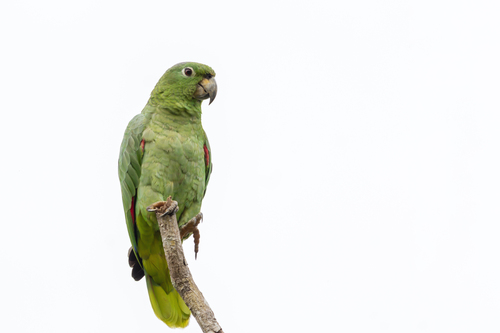
Mealy Amazon
Amazona farinosa
One of the largest and most social parrots of the Americas, the Mealy Amazon is famous for its 'dusted' green plumage and powerful, melodic calls. A true icon of the tropical canopy, these intelligent birds bring a splash of prehistoric wonder to any backyard they visit.
Quick Identification
Size
38–41 cm (15–16 in) in length; weight 540–700g (1.2–1.5 lbs)
Colors
Primary green body with a whitish-grey 'dusted' or mealy appearance; red wing patches; blue-violet nape; white eye-rings
Key Features
- Large, stocky build with a short tail
- Prominent white eye-ring against green feathers
- 'Mealy' powder-like texture on plumage
- Small red patch (speculum) on the wings
When You’ll See Them
Geographic range
Where Does the Mealy Amazon Live?
The Mealy Amazon is a quintessential Neotropical bird, native to the vast tropical regions of Central and South America. Its range stretches from southern Mexico and Panama down through the Amazon Basin into Peru, Bolivia, and southeastern Brazil. These parrots are primarily lowland residents, flourishing in the dense, humid jungles of countries like Colombia, Ecuador, and Venezuela. While they are strictly non-migratory residents in their native range, their intelligence and popularity have led to small, sporadic escaped populations in urban areas, though they remain most common in undisturbed forest corridors.
Basemap © OpenStreetMap contributors
Behavior
While they can be shy in undisturbed forests, they are highly intelligent and observant. They communicate with a wide range of calls, from harsh squawks used during flight to more melodic whistles when perched. Unlike many other Amazon species, they have a reputation for being less aggressive, though their sheer size and powerful beaks make them a dominant presence at feeding sites. Their social bonds are exceptionally strong, with mated pairs remaining together year-round and even grooming each other frequently to reinforce their connection.
EverydayEarth exclusive
Camera Tips
Timing is a critical factor for success. Configure your AI camera to be most sensitive during the 'commute hours'—the first two hours after sunrise and the final hour before sunset. This is when Mealy Amazons are most active and vocal as they move between roosting and feeding sites. Using a camera with a fast trigger speed is essential, as these large birds can be surprisingly quick when landing or taking off, often resulting in motion blur on slower devices.
For the best visual results, ensure your camera is positioned with the sun at its back to highlight the subtle 'mealy' texture of their feathers. This distinctive 'powdered' look is often lost in shadows or harsh backlighting. If your backyard camera supports high-definition video with sound, enable it; the unique vocalizations of the Mealy Amazon are just as much a part of the identification process as their physical appearance. Avoid using artificial lures or birdseed, as these parrots prefer fresh fruit and natural foraging opportunities.
Similar Species
Species that look similar or are commonly confused with Mealy Amazon.
Yellow-naped Amazon
Smaller with a distinct bright yellow patch on the back of the neck and lacks the 'floury' feather texture.
Festive Amazon
Has a prominent red patch on the lower back and red lores (the area between the eye and beak).
Scaly-naped Amazon
Found at higher elevations and has dark edges on the neck feathers giving a 'scaly' look rather than a 'mealy' look.
Frequently Asked Questions
Record Mealy Amazon at your habitat
Connect a camera to start building your own species record — AI identifies every visitor automatically.