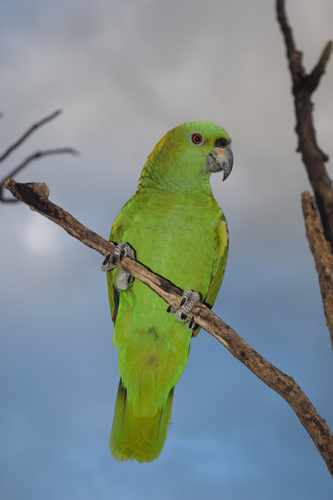
Yellow-naped Amazon
Amazona auropalliata
A masterpiece of the Pacific lowlands, the Yellow-naped Amazon is as famous for its brilliant green plumage as it is for its legendary mimicry. Now a rare sight due to its Critically Endangered status, capturing this intelligent parrot on camera is a true birding milestone.
Quick Identification
Size
Length of 33–38 cm (13–15 in); wingspan of approx 65–72 cm (25–28 in); weight ranges from 450–650 g (1–1.4 lbs).
Colors
Primary plumage is a vibrant leaf-green. Adults feature a distinct yellow patch on the lower nape (back of the neck) and red patches on the wing bends (speculum). The beak is a dark charcoal to pale horn color. Males and females are identical in appearance.
Key Features
- Bright yellow patch on the back of the neck
- Heavy, dark gray beak with a hooked upper mandible
- Stocky green body with a short, square tail
- Red wing feathers visible primarily during flight
When You’ll See Them
Geographic range
Where Does the Yellow-naped Amazon Live?
The Yellow-naped Amazon is native to the Pacific coast of Mesoamerica, spanning from southern Mexico through Guatemala, El Salvador, Honduras, and Nicaragua, down to northwestern Costa Rica. It is a lowland specialist, rarely venturing into high-altitude cloud forests, preferring the warmer coastal plains and deciduous woodlands. While its native range is shrinking, small feral populations resulting from escaped pets are occasionally reported in urban areas of Florida and California.
Basemap © OpenStreetMap contributors
Behavior
Yellow-naped Amazons are renowned for their exceptional intelligence and sophisticated vocalizations. In the wild, they are highly social creatures, typically seen in pairs or small family groups that maintain strong social bonds through complex vocal duets. They are famous for their ability to mimic sounds, a trait that in the wild helps them communicate within their flock and identify their mates.
Their daily routine is highly predictable: they depart from communal roosting sites at dawn with loud, raucous calls, traveling to various feeding grounds throughout the day. While foraging, they are surprisingly quiet and acrobatic, often hanging upside down to reach choice fruits. They are long-lived birds, sometimes reaching ages of 50 to 60 years, and they exhibit deep site fidelity, returning to the same nesting and roosting trees for decades.
EverydayEarth exclusive
Camera Tips
To capture high-quality footage of a Yellow-naped Amazon, you must look up. These parrots are strictly arboreal and will almost never visit the ground. Mount your camera at least 15 to 20 feet high, ideally on a branch overlooking a known food source like a fruiting fig or mango tree. If you are using a backyard setup, an elevated platform feeder or a high-mounted birdbath is your best bet, as these birds are increasingly drawn to residential areas for reliable water during the dry season.
Because of their vibrant green plumage, they can easily blend into the canopy, making them a challenge for standard motion sensors. Use a camera with high-sensitivity AI detection tuned for birds, and ensure the lens is positioned to capture the bird's profile. This allows the camera to record the diagnostic yellow nape patch. Angling the camera slightly downward from a higher branch toward a lower 'perching branch' can provide the most dramatic and clear identification shots.
Lighting is a significant factor in the rainforest or thick suburban canopies. Aim your camera toward the east or west to take advantage of the 'golden hour' light, which occurs when these birds are most active. Avoid placing the camera where it will face the direct midday sun, which can wash out the subtle textures of their feathers. If your camera allows for manual settings, a faster shutter speed is recommended to freeze their quick, jerky head movements while they manipulate seeds or fruit.
Finally, consider the seasonal movements of your local population. During the breeding season (January to May), they are more likely to visit the same nesting cavities repeatedly. If you identify a nesting tree, place your camera on a nearby trunk with a clear line of sight to the cavity entrance. Be sure to keep a respectful distance and use a zoom lens or high-resolution sensor to avoid disturbing the birds during this critical time.
Similar Species
Species that look similar or are commonly confused with Yellow-naped Amazon.
Frequently Asked Questions
Record Yellow-naped Amazon at your habitat
Connect a camera to start building your own species record — AI identifies every visitor automatically.