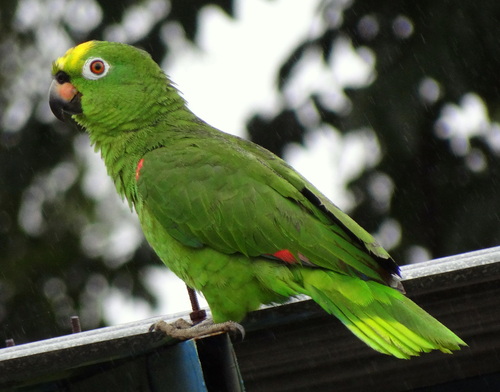
Yellow-crowned Amazon
Amazona ochrocephala
A vibrant and vocal resident of the tropical canopy, the Yellow-crowned Amazon is famous for its brilliant green plumage and social intelligence. This charismatic parrot is a master of the treetops, bringing a splash of gold and a loud tropical energy to the forests of South America.
Quick Identification
Size
33-38 cm (13-15 in) long; wingspan approx. 60-70 cm (24-28 in); weight 340-535 g (12-19 oz)
Colors
Primarily bright green plumage with a distinct yellow patch on the forehead and crown. Adults feature red markings on the wing bend (speculum) and occasionally yellow or lime green on the thighs. Beaks are dark grey with a reddish spot near the base.
Key Features
- Bright yellow patch restricted to the forehead and crown
- Dark grey beak with reddish coloration on the upper mandible
- Vivid red wing speculum visible during flight
- Stocky build with a short, square tail
When You’ll See Them
Geographic range
Where Does the Yellow-crowned Amazon Live?
Native to the tropical regions of the Americas, the Yellow-crowned Amazon is primarily found across the vast Amazon Basin of South America and northward into Panama. Its core range includes countries such as Brazil, Venezuela, Colombia, and the Guyanas, as well as the Caribbean islands of Trinidad and Tobago. While they are lowland specialists, they have successfully adapted to human-altered landscapes near forest edges and river corridors throughout their native territory.
Basemap © OpenStreetMap contributors
Behavior
During the day, they exhibit a rhythmic pattern of activity, leaving communal roosts at sunrise to find feeding grounds. While they can be cautious and wary of predators, they often become habituated to human presence in suburban areas or plantations where food is abundant. Their social structure is stable, with pairs often staying together for life and engaging in mutual preening to reinforce their bond.
EverydayEarth exclusive
Camera Tips
Lighting is your best friend when filming these birds; their green feathers can easily get lost in the shadows of dense foliage. Try to orient your camera so it catches the early morning or late afternoon sun, which will make the yellow crown and red wing patches pop in your footage. Use a high-resolution setting and a fast trigger speed, as these parrots move their heads quickly when scanning for danger or manipulating food.
If you are using an AI-powered camera in a backyard setting, a tall, elevated water basin can be an excellent lure. Parrots are social drinkers and will often land in groups, providing long sequences of interesting behavior. During the dry season, a consistent water source is particularly irresistible. Ensure your camera's motion zone is tight enough to avoid being triggered by wind-blown leaves, which are common in the breezy canopy where these birds prefer to perch.
Similar Species
Species that look similar or are commonly confused with Yellow-crowned Amazon.
Yellow-headed Amazon
The yellow coloration covers the entire head and throat, rather than just the crown and forehead.
Yellow-naped Amazon
The yellow patch is located on the back of the neck (nape) rather than the forehead, and the beak is typically entirely dark.
Orange-winged Amazon
Features blue feathers around the eyes and orange (rather than red) patches in the wings and tail.
Frequently Asked Questions
Record Yellow-crowned Amazon at your habitat
Connect a camera to start building your own species record — AI identifies every visitor automatically.