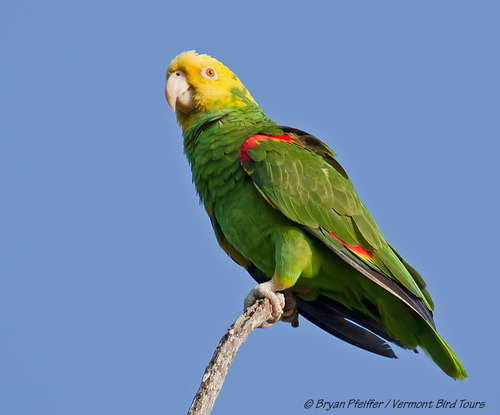
Yellow-headed Amazon
Amazona oratrix
The Yellow-headed Amazon is an iconic, golden-crowned parrot known for its incredible intelligence and vocal talent. Though rare in its native wild forests, this vibrant bird is a spectacular sight in suburban canopies across the Americas.
Quick Identification
Size
38–43 cm (15–17 in) in length; wingspan approx. 20–22 in; weight 450–550g (1.0–1.2 lbs)
Colors
Primary emerald green body; bright yellow head and throat in adults; red and yellow patches on the wing bend (speculum); pale ivory beak; white eye-ring.
Key Features
- Full brilliant yellow head and throat (on mature adults)
- Vibrant red patch at the shoulder/bend of the wing
- Heavy, pale horn-colored bill
- Short, square tail with yellow-green terminal band
When You’ll See Them
Geographic range
Where Does the Yellow-headed Amazon Live?
Native to the tropical lowlands of North and Central America, the Yellow-headed Amazon is primarily found along the coastal slopes of Mexico, Belize, and northern Guatemala. While their wild populations have suffered significantly from habitat loss, they are remarkably resilient in urban settings. Significant naturalized populations are now established in several parts of the United States, most notably in the suburban landscapes of Southern California, South Florida, and coastal Texas.
Basemap © OpenStreetMap contributors
Behavior
The Yellow-headed Amazon is a highly social and intelligent parrot, famous for its exceptional ability to mimic human speech and other sounds. In the wild, they are almost never seen alone, typically traveling in pairs or loud, boisterous flocks. They are diurnal, spending their mornings and late afternoons foraging for food and their midday hours resting in the shade of dense foliage to avoid the heat.
These parrots are extremely vocal, using a complex system of squawks and shrieks to maintain contact with the flock and defend their territory. They form strong, lifelong pair bonds and are known for their playful, albeit sometimes aggressive, personalities. In areas where they live near humans, they often become comfortable in suburban environments, provided there are enough tall trees for roosting and a steady supply of fruit-bearing plants.
EverydayEarth exclusive
Camera Tips
To capture high-quality footage of a Yellow-headed Amazon, you need to look up. These birds are almost exclusively arboreal and rarely descend to the ground. Mount your AI-powered camera at a height of 10 to 15 feet, ideally overlooking a known feeding perch or a fruit-bearing tree like mango, guava, or loquat. If you don't have a tall ladder, look for a balcony or a second-story window ledge that provides a clear line of sight into the mid-to-upper canopy of your backyard trees.
Water is a powerful attractant for these parrots, especially in the heat of the afternoon. A high-elevation birdbath or a fountain with a steady drip can lure them into camera range. Position your camera so it has a clear view of the water's edge where the bird is likely to land. Because these parrots have a stocky build and can be heavy, ensure any perches or feeders within the frame are sturdy enough to support a bird weighing over a pound.
Timing is critical for these early risers. Set your camera's sensitivity to high during the first two hours of daylight, as this is when the Yellow-headed Amazon is most active and vocal. If your camera allows for video recording, enable it; their social interactions—such as preening a mate or their dramatic vocalizations—are much more engaging to watch than still photos. Finally, avoid placing the camera in a spot where it will face the direct morning sun, as the flare can wash out the brilliant yellow feathers that the AI needs to identify the species correctly.
Similar Species
Species that look similar or are commonly confused with Yellow-headed Amazon.
Yellow-crowned Amazon
Smaller yellow patch limited to the forehead and crown; lacks the full yellow head of the Yellow-headed species.
Red-lored Amazon
Features a prominent red patch above the beak (lores) and blue feathers on the crown, rather than a solid yellow head.
Lilac-crowned Amazon
Has a maroon forehead and a duller green body with a distinct lilac-colored wash on the back of the neck and crown.
Frequently Asked Questions
Record Yellow-headed Amazon at your habitat
Connect a camera to start building your own species record — AI identifies every visitor automatically.