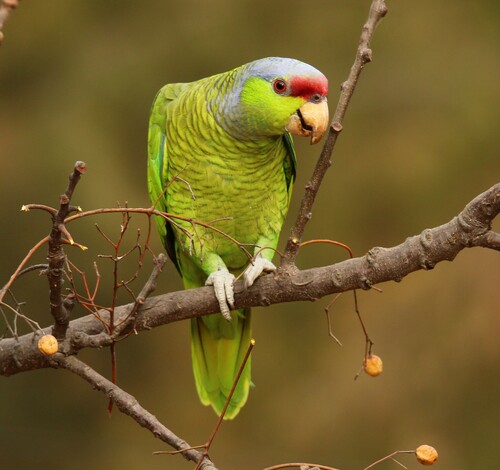
Lilac-crowned Amazon
Amazona finschi
With its stunning violet-blue crown and spirited personality, the Lilac-crowned Amazon is a crown jewel of the Pacific slopes and suburban skies alike.
Quick Identification
Size
30-34 cm (12-13.5 inches) in length; wingspan of approximately 60 cm (24 inches); weight ranges from 280-320g (10-11 oz)
Colors
Bright green body with a distinct maroon-red forehead and a pale lilac to violet-blue wash over the crown and nape; wing feathers show a red speculum during flight
Key Features
- Maroon-red forehead ('brow')
- Lilac-blue wash on crown and neck
- Green plumage with dark scalloping on edges
- Pale, horn-colored bill and yellow-orange eyes
When You’ll See Them
Geographic range
Where Does the Lilac-crowned Amazon Live?
Native to the North American continent, the Lilac-crowned Amazon is endemic to the Pacific slopes of Mexico, ranging from eastern Sonora south to Oaxaca. While its core wild population remains in the Mexican tropical dry forests, significant feral populations have become well-established in the United States, particularly in the urban landscapes of Southern California and parts of Florida and Texas. These resilient birds thrive in suburban corridors where ornamental fruit-bearing trees provide a year-round food source.
Basemap © OpenStreetMap contributors
Behavior
Lilac-crowned Amazons are highly social and intelligent parrots that spend much of their lives in synchronized flocks. In the wild, they are known for their loud, raucous calls that echo through the forest canopy, particularly during their morning and evening commutes between roosting sites and feeding grounds. They are acrobatic foragers, often hanging upside down to reach the choicest fruits or seeds.
In urban environments, such as Southern California, they have adapted remarkably well to human presence. While they can be wary of direct contact, they are creatures of habit, often visiting the same suburban gardens and fruiting trees at the same time every day. They exhibit complex social hierarchies and are frequently seen in pairs within larger flocks, as they form strong, long-term pair bonds.
EverydayEarth exclusive
Camera Tips
To capture these vibrant parrots, position your camera at a significant height. Lilac-crowned Amazons are arboreal and rarely descend to the ground, so mounting your device on a high fence post, a balcony railing, or a tree limb overlooking a known feeding site is essential. If you have a bird bath, place the camera nearby, as these parrots are attracted to water for drinking and cooling off during the heat of the day.
Food is the best lure for backyard sightings. They are especially attracted to sunflower seeds, walnuts, and fresh tropical fruits like pomegranate or figs. Setting your camera to a high-speed burst mode is recommended, as their movements while feeding can be erratic and fast. Because they are most active during the 'golden hours' of dawn and dusk, ensure your camera has a wide aperture or good low-light performance to capture the subtle lilac hues of their crown.
Consider the angle of the sun when placing your camera; the brilliant green and violet feathers of the Lilac-crowned Amazon look most spectacular when front-lit by the morning sun. If you are tracking a local urban flock, try to identify their favorite 'scout trees'—the high, bare-limbed trees where they land first before descending into a garden to feed. Placing a camera with a view of these perches will capture great social interaction shots.
Similar Species
Species that look similar or are commonly confused with Lilac-crowned Amazon.
Frequently Asked Questions
Record Lilac-crowned Amazon at your habitat
Connect a camera to start building your own species record — AI identifies every visitor automatically.