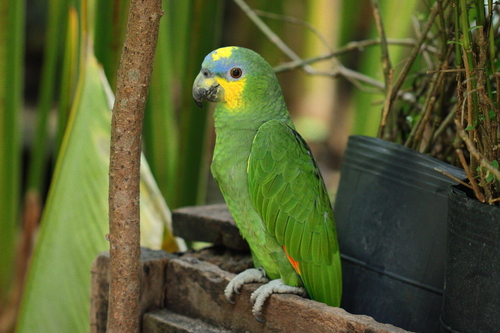
Orange-winged Amazon
Amazona amazonica
A vibrant icon of the South American canopy, the Orange-winged Amazon is a social, intelligent parrot known for its brilliant facial colors and boisterous morning calls.
Quick Identification
Size
31-33 cm (12-13 in) in length; wingspan of 60-70 cm (24-27 in); weight 340-480 g (12-17 oz)
Colors
Mainly green body; blue feathers on the forehead and around eyes; yellow crown and cheeks; distinct orange patches on the speculum (wing feathers) and tail
Key Features
- Bright orange wing patch visible in flight
- Turquoise-blue mask across the forehead and eyes
- Yellow feathers on crown and cheeks
- Short, squared-off tail with orange and green banding
When You’ll See Them
Geographic range
Where Does the Orange-winged Amazon Live?
Native to the lush tropical regions of South America, the Orange-winged Amazon occupies a massive territory spanning from Colombia, Venezuela, and the Guianas down through the Amazon basin to Peru, Bolivia, and central Brazil. They are prominent residents of the islands of Trinidad and Tobago and have successfully established feral breeding populations in Puerto Rico and the Canary Islands. As adaptable survivors, they thrive in both deep primary rainforests and modified landscapes like suburban groves.
Basemap © OpenStreetMap contributors
Behavior
The Orange-winged Amazon is a highly social and gregarious parrot, almost always found in pairs or loud, bustling flocks that can number in the hundreds. They are famous for their communal roosting habits, where they gather in tall trees at dusk, creating a cacophony of screeches and whistles that can be heard from over a mile away. These birds are most active during the 'commuter hours' of dawn and dusk as they fly between their sleeping sites and various feeding grounds.
In the wild, they exhibit complex social structures and are known for their intelligence and problem-solving abilities. While they are often cautious around humans in areas where they are hunted, in suburban environments or protected parks, they can become quite bold. They spend a significant portion of their day foraging in the canopy, using their powerful beaks and zygodactyl feet (two toes forward, two back) to maneuver through branches and crack open tough nuts.
EverydayEarth exclusive
Camera Tips
To capture the Orange-winged Amazon on an AI-powered camera, height is your best friend. These birds are canopy dwellers and rarely descend to the ground unless they are visiting a very specific water source or ground-level mineral lick. Mount your camera at least 10 to 15 feet high, ideally on a branch overlooking a known fruiting tree like mango, guava, or palm. Angle the camera slightly downward to catch them as they land on exterior branches where they prefer to perch before moving into the denser foliage.
If you are trying to attract them to a backyard setup, fresh water is often more effective than food. A raised birdbath or a dripping water feature placed high up can be an irresistible lure, especially during the dry season. For food lures, large sunflower seeds or chunks of tropical fruit can work, but be prepared for other species to visit as well. Set your camera's trigger sensitivity to high; these parrots are fast flyers and you want to catch the moment they bank their wings, which is when the namesake orange patches are most visible to the AI's sensors.
Lighting is crucial for identifying this species correctly. Position your camera so the sun is at its back during the morning or late afternoon peaks. This 'front-lighting' will illuminate the subtle blue and yellow facial markings that distinguish them from other similar-looking green amazons. Use a fast shutter speed or 'Burst Mode' to ensure the bird isn't a green blur, as they are constantly moving their heads and shifting their weight while feeding.
Finally, consider the audio capabilities of your camera. The Orange-winged Amazon is exceptionally vocal. If your AI camera supports sound detection, listen for their high-pitched 'kee-wick' calls or metallic shrieks. This audio data can often alert you to their presence before they even enter the camera's field of view, allowing you to optimize your placement for the next day's activity.
Similar Species
Species that look similar or are commonly confused with Orange-winged Amazon.
Yellow-crowned Amazon
Lacks the blue facial markings and has red wing patches instead of orange.
Turquoise-fronted Amazon
Features much more extensive blue on the forehead and a bright red bend at the shoulder.
Mealy Amazon
Significantly larger with a 'dusty' grey-green appearance and lacks the bright orange and blue head markings.
Frequently Asked Questions
Record Orange-winged Amazon at your habitat
Connect a camera to start building your own species record — AI identifies every visitor automatically.