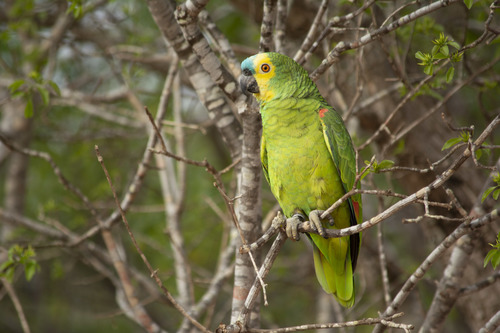
Turquoise-fronted Amazon
Amazona aestiva
With its stunning blue forehead and boisterous personality, the Turquoise-fronted Amazon is the vibrant soul of the South American canopy. A master of mimicry and a social powerhouse, this parrot brings a splash of tropical brilliance to any backyard it visits.
Quick Identification
Size
Length: 35–37 cm (14–15 in); Wingspan: approx. 65 cm (26 in); Weight: 400–500 g (14–18 oz)
Colors
Primary green plumage with a turquoise-blue forehead, yellow patches on the crown and throat, and red splashes on the wing bends.
Key Features
- Distinctive turquoise-blue patch above the beak
- Yellow plumage around the eyes and throat
- Scalloped green feathers with dark edges
- Bright red wing speculum visible during flight
When You’ll See Them
Geographic range
Where Does the Turquoise-fronted Amazon Live?
Native to the heart of South America, the Turquoise-fronted Amazon thrives across a wide belt of the continent. Its core range spans from eastern and central Brazil through the lush Chaco regions of Paraguay and northern Argentina, extending into the eastern lowlands of Bolivia. While they are a staple of the South American wilderness, feral populations have also established themselves in various urban centers globally, including parts of Europe and North America, due to their popularity in the pet trade.
Basemap © OpenStreetMap contributors
Behavior
The Turquoise-fronted Amazon is a highly social and intelligent parrot, often found in pairs or large, boisterous flocks. They are famous for their loud, raucous calls, which serve as a communication tool to keep the flock together during morning and evening transitions between roosting sites and feeding grounds. In the wild, they exhibit a cautious but curious nature, often spending hours meticulously preening or engaging in social play with their mates.
These parrots are diurnal and follow a strict routine, beginning their day with a vocal 'dawn chorus' before dispersing to find food. They are incredibly dexterous, frequently using their feet like hands to manipulate fruit and seeds. When interacting with humans in suburban environments, they can become quite bold, often visiting the same bird feeders or fruiting trees daily once they feel a location is safe.
EverydayEarth exclusive
Camera Tips
To successfully capture the Turquoise-fronted Amazon on your backyard camera, height is your best friend. These are canopy-dwelling birds that rarely descend to the ground except for water. Mount your camera at a height of at least 6 to 10 feet, ideally angled toward a sturdy horizontal branch or a high-mounted platform feeder. If you have a fruiting tree like a mango, guava, or palm, position the camera to face the ripening fruit, as the birds will return to the same spot daily until the harvest is gone.
Baiting is highly effective for this species. They are particularly attracted to sunflower seeds, walnuts, and fresh tropical fruits like papaya or citrus. If you use a platform feeder, ensure it is robust, as these parrots can be quite heavy and active. Placing a elevated bird bath or water source can also be a magnet, especially during the dry season, as they enjoy a vigorous afternoon splash to keep their feathers in top condition.
For camera settings, prioritize a fast shutter speed or high-frame-rate video. These parrots move their heads quickly when scanning for predators and can be a blur of green if the shutter is too slow. Since they are most active during the 'golden hours' of dawn and dusk, ensure your camera has good low-light performance or is positioned to catch the morning sun, which will make their turquoise and yellow facial feathers pop against the green foliage.
Similar Species
Species that look similar or are commonly confused with Turquoise-fronted Amazon.
Frequently Asked Questions
Record Turquoise-fronted Amazon at your habitat
Connect a camera to start building your own species record — AI identifies every visitor automatically.