Festive Amazon
Amazona festiva
A vibrant specialist of the South American riverfronts, the Festive Amazon is easily identified by its striking red rump and social personality. Watch for them in pairs as they navigate the flooded forests and mangroves of the Amazon basin.
Quick Identification
Size
33–35 cm (13–14 inches) in length; wingspan of approximately 60–65 cm (24–26 inches); weighs around 350–390 g (12–14 oz).
Colors
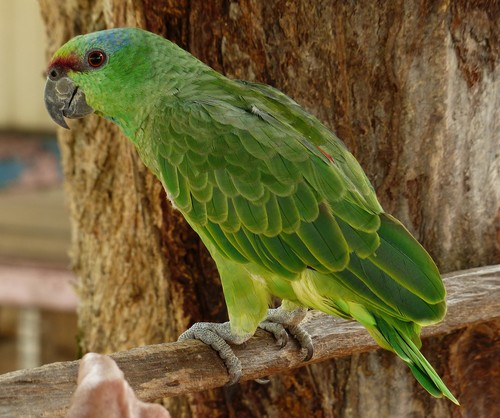
Primary plumage is bright green; features a distinctive red patch on the lower back and rump. A narrow dark red or maroon band sits across the forehead, with violet-blue plumage above the eyes and on the throat.
Key Features
- Bright red lower back and rump patch
- Dark maroon band between the eyes
- Vibrant green body with blue-toned throat
- Medium-sized, stocky parrot profile
When You’ll See Them
Geographic range
Where Does the Festive Amazon Live?
The Festive Amazon is a quintessential South American species, calling the lush waterways of the Amazon and Orinoco basins home. Its primary range stretches across the tropical heart of Brazil, Colombia, Peru, and Venezuela, with smaller populations reaching into Ecuador, Bolivia, and Guyana. These parrots are specialists of the riverbanks, rarely straying far from the water's edge where they find the specific fruiting trees they need to thrive.
Basemap © OpenStreetMap contributors
Behavior
The Festive Amazon is a highly social and vocal parrot, typically observed in pairs or small family groups. They are most famous for their communal roosting habits, where dozens or even hundreds of individuals gather in the canopy of riverine forests at sunset. Their daily routine involves loud, synchronized flights between roosting sites and feeding grounds, filling the air with a variety of squawks and metallic calls that are a staple sound of the Amazonian dawn.
These birds are exceptionally well-adapted to life near the water. They are frequently seen flying across wide rivers or perched in the tangled vegetation of flooded forests. While they can be cautious around humans in areas where habitat encroachment is high, they are known for their playful intelligence and can become quite accustomed to human presence in protected gardens or eco-lodges, where they may investigate fruiting trees with curiosity.
EverydayEarth exclusive
Camera Tips
To successfully capture a Festive Amazon on camera, you must think vertically. These parrots spend the vast majority of their lives in the canopy, so ground-level setups will rarely catch them. Mount your camera at least 10 to 15 feet high on a tree trunk, ideally overlooking a known 'food tree' like a fruiting palm or guava. Using a tree-climbing mount or a specialized pole can help achieve the necessary height to get eye-level shots of their foraging behavior.
Water is a significant draw for this species. If you have a raised birdbath or a platform near a riverbank, position your camera to face the water source. Festive Amazons are wary, so ensure the camera is well-camouflaged and use a long-range PIR (Passive Infrared) sensor setting to trigger the camera before they fly off. Since they move in pairs, a wide-angle lens is better than a tight zoom, allowing you to capture the social interaction between mates.
Lighting is your biggest challenge in the dense jungle or wooded gardens. Set your camera to a higher ISO or use a model with excellent low-light performance to handle the shadows of the canopy. Avoid using a bright white flash, which will startle the birds; instead, rely on high-quality infrared (no-glow) for early morning triggers. Schedule your camera's active window for the 'golden hours'—the two hours after sunrise and the two hours before sunset—when the birds are most active and the light is most flattering for their green and red plumage.
Similar Species
Species that look similar or are commonly confused with Festive Amazon.
Red-lored Amazon
Lacks the red rump patch and has a much more extensive red area on the forehead and lores.
Mealy Amazon
Significantly larger with a 'dusted' or floury appearance to its green feathers and no red rump.
Yellow-crowned Amazon
Has a yellow patch on the crown and lacks the maroon facial band and red rump of the Festive Amazon.
Frequently Asked Questions
Record Festive Amazon at your habitat
Connect a camera to start building your own species record — AI identifies every visitor automatically.