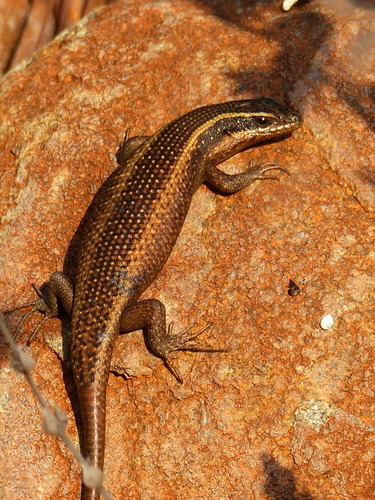
Speckled Rock Skink
Trachylepis punctatissima
A master of the sun-drenched rock, the Speckled Rock Skink is a vibrant, speckled gem of the Southern African landscape. Common in gardens and mountains alike, this hardy lizard brings a touch of prehistoric charm to any backyard.
Quick Identification
Size
Total length of 16-22 cm (6-9 inches); Snout-vent length (SVL) is typically 7-9 cm (2.8-3.5 inches).
Colors
Dark chocolate brown to blackish body heavily covered in small, cream or gold specks that occasionally form broken, irregular lines. The underside is typically a uniform silvery-grey or off-white.
Key Features
- Dense white or gold speckling on a dark base
- Long, tapering tail often longer than the body
- Smooth, glossy scales with a metallic sheen
- Large, distinct ear openings
When You’ll See Them
Geographic range
Where Does the Speckled Rock Skink Live?
This resilient lizard is native to the southern African subcontinent, thriving across a wide swathe of the region's diverse landscapes. Its core range encompasses much of South Africa, Lesotho, and Eswatini, extending northward into Zimbabwe, eastern Botswana, Malawi, and parts of Zambia. While it favors middle to high-altitude environments, it is remarkably adaptable and has established stable populations in both wild mountain ranges and bustling urban centers throughout these countries.
Basemap © OpenStreetMap contributors
Behavior
The Speckled Rock Skink is a bold and energetic lizard frequently seen basking on warm rocks, brick walls, or tree trunks during the day. Unlike many shy reptiles, they are quite comfortable around human habitation and are a common sight in suburban gardens across Southern Africa, where they scurry away with a characteristic rustle when approached. They are heliotherms, meaning they rely on direct sunlight to regulate their body temperature, often spending the early morning hours flattened against a dark surface to absorb heat.
These skinks are primarily solitary but can be found in high densities where basking spots and food are abundant. They are highly active hunters, using their keen eyesight to spot movement from a distance before darting out to capture prey. Interestingly, they are ovoviviparous, meaning the females give birth to 3-9 fully formed live young during the summer rather than laying eggs. This is an evolutionary adaptation that allows them to thrive in the cooler temperatures of high-altitude mountain ranges.
EverydayEarth exclusive
Camera Tips
To capture high-quality footage of the Speckled Rock Skink, focus your camera on prominent basking sites. These lizards love flat, sun-exposed surfaces like the tops of stone walls, large garden rocks, or woodpiles. Set your camera at a low angle, roughly 5-10 inches off the ground, to get an eye-level perspective that highlights their intricate speckling and alert expressions. Because they are small and fast, a camera with a high trigger speed and a short focal distance is essential for clear shots.
Baiting isn't strictly necessary, but you can encourage them to linger in front of the lens by placing a 'feeding station' nearby. A shallow dish with a few mealworms or a smear of overripe fruit, like mashed banana, can entice them to stay still long enough for a high-resolution photo. Position the bait in a patch of direct sunlight, as they are most likely to feed while they are warming up their bodies for the day.
Timing is everything with this species. They are strictly diurnal and depend entirely on the sun's heat. Program your camera to be most active from mid-morning to late afternoon. In the cooler months, they may only emerge for a few hours during the hottest part of the day. Using a 'Time Lapse' mode at 30-second or 1-minute intervals during peak basking hours can often yield better results than PIR-only triggers, which might miss their quick, darting movements.
For the best visual results, ensure there is minimal vegetation immediately in front of the lens to prevent false triggers from wind. Since these skinks are often found near human dwellings, trail cameras can be mounted directly to walls or fence posts using adhesive mounts or straps. Look for areas where you've seen them scurry—they are creatures of habit and will often use the same crevices for shelter and the same rocks for sunning every single day.
Similar Species
Species that look similar or are commonly confused with Speckled Rock Skink.
Frequently Asked Questions
Record Speckled Rock Skink at your habitat
Connect a camera to start building your own species record — AI identifies every visitor automatically.