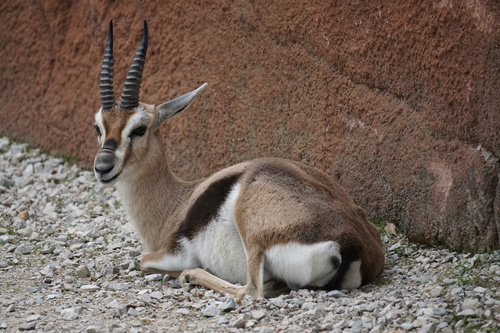
Speke's Gazelle
Gazella spekei
The Speke's Gazelle is a pint-sized desert survivor, famous for its unique 'honking' nose and striking facial stripes. As the smallest gazelle on Earth, this endangered beauty is a rare and rewarding sight for any wildlife enthusiast.
Quick Identification
Size
Shoulder height 50–60 cm (20–24 in); Weight 15–25 kg (33–55 lbs)
Colors
Pale fawn or brownish-gray upper body with a bright white underbelly; a distinct dark horizontal band runs along the flank. Facial markings include white stripes from horns to muzzle.
Key Features
- Smallest gazelle species in the world
- Unique inflatable skin fold on the bridge of the nose
- Lyrate, heavily-ringed horns found on both sexes
- Dark lateral stripe separating fawn back from white belly
When You’ll See Them
Behavior
Speke’s Gazelles are highly social and alert animals, usually moving in small herds of five to twenty individuals. To survive in the open, arid landscapes of the Horn of Africa, they have developed a keen sense of sight and hearing. Their most fascinating behavioral trait is their use of a specialized nasal sac; when threatened or alarmed, they inflate this skin fold to produce a loud, resonant clicking or 'honking' sound that warns the rest of the herd of approaching predators.
Within their social groups, dominant males are strictly territorial, using dung heaps and secretions from their preorbital glands to mark their domain. They are remarkably agile and can reach high speeds when fleeing, often utilizing a 'stott' or 'pronk'—a stiff-legged jump—to demonstrate their fitness to predators. While naturally shy around humans, they are primarily active during the cooler morning and evening hours to conserve energy in their harsh desert environment.
EverydayEarth exclusive
Camera Tips
Capturing the Speke's Gazelle on camera requires a strategic approach due to their small stature and skittish nature. Because they are the smallest of all gazelles, you must mount your camera much lower than you would for other ungulates. A height of 18 to 24 inches is ideal. Angle the camera slightly upward to ensure you capture the full silhouette, including their distinctive horns and facial markings. Placing the camera too high will result in 'top-down' shots that miss the identifying flank stripes and nasal folds.
Timing and environment are critical for success. These gazelles are most active during the 'golden hours' of dawn and dusk when they emerge to forage before the desert heat peaks. Set your camera to a high trigger speed (0.3 to 0.5 seconds) and use 'Burst Mode' or 'Photo + Video' settings. Gazelles are incredibly fast and twitchy; a single photo often catches only a blur or a retreating tail, but a three-shot burst significantly increases your chances of getting a clear, profile-view 'hero shot.'
In their arid home range, water is the ultimate attractant. If you have access to a watering hole or a low-profile trough, position your camera 10-15 feet away with the sun at the camera's back to avoid lens flare. If water isn't available, look for 'latrine' sites—areas where males consistently leave dung to mark territory. These spots are visited frequently and provide the best opportunity for stationary shots. Ensure your camera is well-camouflaged with desert-toned housing or local brush, as their sharp eyes are highly sensitive to unnatural shapes and movements.
Similar Species
Species that look similar or are commonly confused with Speke's Gazelle.
Frequently Asked Questions
Record Speke's Gazelle at your habitat
Connect a camera to start building your own species record — AI identifies every visitor automatically.