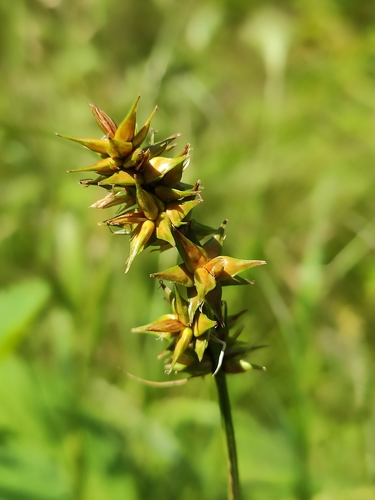
Spiked Sedge
Carex spicata
A striking, clump-forming perennial that adds architectural flair and vital habitat to the backyard. With its star-like seed heads and unique triangular stems, the Spiked Sedge is a favorite for low-profile wildlife spotting.
Quick Identification
Size
Stems typically reach 10–85 cm (4–33 inches) in height; flower spikes are roughly 5–10 mm (0.2–0.4 inches) wide.
Colors
Bright lime-green stems and leaves; flower clusters are yellowish-green when young, turning a rusty brown as they mature; distinct purple-red tinting at the base of the plant.
Key Features
- Triangular-shaped stems (edges feel sharp to the touch)
- Densely packed, star-shaped flower spikes (inflorescences)
- Vibrant purple-red coloring at the base of the stem sheaths
When You’ll See Them
Behavior
Spiked Sedge is a hardy, perennial plant that grows in dense, tufted clumps known as tussocks. Unlike many aggressive garden grasses, it spreads slowly through a compact rhizome system, making it an excellent choice for maintaining structure in a wild garden or meadow. It is often one of the first species to emerge in early spring, providing critical early-season ground cover for small invertebrates and amphibians.
As a wind-pollinated species, the Spiked Sedge does not produce nectar-rich flowers to attract insects; instead, it releases fine clouds of pollen into the breeze during late spring. Once the seeds (perigynia) ripen in the heat of summer, they become an important foraging resource for ground-feeding birds like sparrows and finches. In the backyard, it acts as a resilient stabilizer for soil, often colonizing areas where traditional lawns struggle to grow due to compaction or varying light levels.
EverydayEarth exclusive
Camera Tips
Capturing a plant like Spiked Sedge with an AI-powered camera requires a shift in strategy from moving wildlife. Because sedges don't trigger traditional motion sensors, you should utilize the 'Time-Lapse' feature on your camera. Set your device to take a photo every 4 to 8 hours during the months of May and June. This allows you to create a high-definition growth sequence, documenting the fascinating way the star-shaped spikes emerge from the center of the clump and transition from green to golden brown.
For the best visual results, mount your camera on a short ground stake, positioning the lens only 6 to 12 inches above the soil. Angle the camera slightly upward. This 'bug's-eye view' makes the sedge look majestic and highlights the delicate textures of the seed heads against the sky. It also places the camera in the perfect position to capture 'interactors'—the ants, beetles, and ladybugs that frequently climb the triangular stems to hunt or seek shelter. If your camera has a macro setting or an adjustable focus, use it to hone in on the base of the stems to document the species-defining purple coloration.
To capture traditional wildlife using the Spiked Sedge as a backdrop, place your camera near a clump that is positioned between a water source and a thicket. Small songbirds like dunnocks or towhees often use the stiff, upright stems of the sedge as a 'staging post' to scan for predators before hopping down to the ground. If you are using a motion-activated camera, set the sensitivity to 'Medium' to avoid hundreds of triggers from the plant swaying in the wind, but keep it high enough to catch the rapid movement of a bird landing on a stem.
Seasonal lighting is your best friend when photographing this species. During the 'golden hours' of dawn and dusk, the low-angle sun will catch the serrated edges of the sedge leaves and the spiky protrusions of the seeds, creating a beautiful halo effect. This is the ideal time to check your camera's positioning to ensure the plant isn't lost in the shadows of larger garden shrubs.
Similar Species
Species that look similar or are commonly confused with Spiked Sedge.
Frequently Asked Questions
Record Spiked Sedge at your habitat
Connect a camera to start building your own species record — AI identifies every visitor automatically.