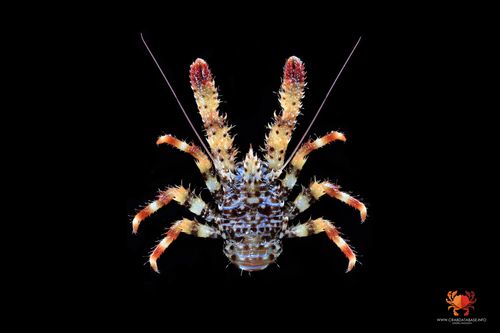
Spiny Squat lobster
Galathea strigosa
The Spiny Squat Lobster is the jewel of the Northeast Atlantic, instantly recognizable by its brilliant neon-blue stripes and formidable spiny claws. A master of the rocky crevices, this 'false lobster' brings a splash of electric color to the deep blue sea.
Quick Identification
Size
Total length up to 90 mm (3.5 in); carapace length up to 53 mm (2.1 in)
Colors
Brilliant brick-red or orange-brown body accented by striking, neon-blue transverse stripes across the carapace and abdomen
Key Features
- Vivid neon blue horizontal stripes across the body
- Long, slender claws covered in sharp spines
- Flattened, 'squat' body with the tail folded tightly beneath the thorax
When You’ll See Them
Geographic range
Where Does the Spiny Squat lobster Live?
The Spiny Squat Lobster is a master of the Northeast Atlantic’s rocky coastlines, stretching its reach from the frigid waters of Norway’s North Cape all the way south to the sun-drenched Canary Islands. This vibrant crustacean is also a common inhabitant of the Mediterranean Sea and has been documented within the Red Sea, showcasing a remarkable adaptability to different water temperatures. Whether tucked into a crevice off the coast of the United Kingdom or scouring a reef in the Adriatic, this species is a cornerstone of European and North African marine ecosystems.
Basemap © OpenStreetMap contributors
Behavior
The Spiny Squat Lobster is a reclusive and highly territorial crustacean. Unlike true lobsters, it belongs to the group of crabs known as Anomurans, which are more closely related to hermit crabs. They are primarily nocturnal, spending the daylight hours tucked deep into rocky crevices, under large stones, or within underwater caves. When they do emerge, they move with a characteristic 'scuttling' motion, though they are capable of rapid backward swimming by forcefully flapping their tucked-under tails if they feel threatened.
These creatures are surprisingly aggressive for their size, often engaging in 'claw-waving' displays to defend their preferred hiding spots from other squat lobsters. While they are technically edible, they are rarely caught for food because they are difficult to harvest in large quantities. To humans, they are mostly a delight for divers and coastal explorers, offering a splash of tropical-looking color in the cooler waters of the North Atlantic.
EverydayEarth exclusive
Camera Tips
Capturing the Spiny Squat Lobster on camera requires an underwater setup, such as a waterproof action camera (like a GoPro) or a specialized 'drop-cam' if you live near the coast. Because these animals are strictly nocturnal and sensitive to bright white light, the best results are achieved using high-lumen video lights with a red-light mode. Red light is less visible to many crustaceans, allowing you to observe their natural foraging behavior without scaring them back into their holes.
Placement is everything for this species. Look for rocky overhangs or 'honeycomb' rock formations at the low tide mark or in sublittoral zones. Position your camera on a weighted short-leg tripod, facing a crevice that shows signs of life, such as small molted shells nearby. Angle the lens slightly upward to catch the blue-striped carapace as the lobster emerges. Setting your camera to a wide-angle macro mode is ideal, as these lobsters are relatively small but possess intricate details that look stunning in close-up footage.
To lure a Spiny Squat Lobster into the frame, you can use a perforated bait container filled with crushed oily fish like mackerel or sardines. Secure the bait directly in front of the camera's focal point. Be patient; it may take 20-30 minutes for the lobster to feel safe enough to leave its crevice. If you are using an AI-powered underwater camera, ensure the motion trigger is set to high sensitivity, as their movements can be subtle until they decide to dart toward the food.
Similar Species
Species that look similar or are commonly confused with Spiny Squat lobster.
Frequently Asked Questions
Record Spiny Squat lobster at your habitat
Connect a camera to start building your own species record — AI identifies every visitor automatically.