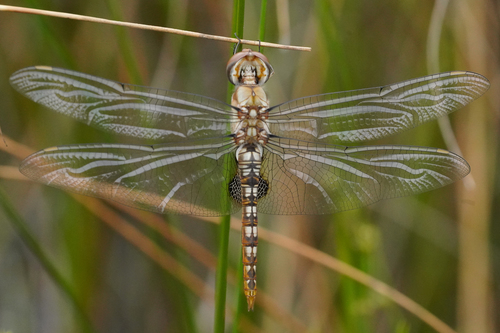
Spot-winged Glider
Pantala hymenaea
The ultimate aerial nomad, the Spot-winged Glider is a golden-hued pilot that travels thousands of miles on the wind. Watch for the signature 'thumbprint' on its wings as it patrols your yard for garden pests.
Quick Identification
Size
Length: 45-50 mm (1.8-2.0 in); Wingspan: 75-80 mm (3.0-3.1 in)
Colors
Golden-brown or tawny orange body; clear wings with a distinctive small, dark brown spot at the base of each hindwing; yellowish face.
Key Features
- Small dark circular spot at the base of the hindwing
- Broad, tapered wings designed for effortless gliding
- Tawny or golden-brown thorax and abdomen
- Large compound eyes that meet at the top of the head
When You’ll See Them
Behavior
Spot-winged Gliders are the master aviators of the dragonfly world. Unlike many other species that spend much of their time perched on twigs or reeds, these gliders are almost constantly in motion. They utilize their broad hindwings to catch thermal updrafts, allowing them to travel vast distances with minimal effort. This species is famous for its migratory habits, often traveling in large swarms across hundreds of miles to follow seasonal rain patterns.
In a backyard setting, you will typically see them patrolling open lawns or hovering over shiny surfaces like swimming pool covers or car hoods, which they occasionally mistake for water. They are highly opportunistic, quickly locating temporary pools formed by heavy rainfall to lay their eggs, ensuring their larvae hatch in a habitat free from predatory fish. While they are solitary hunters, you may see several congregating in an area with a high density of gnats or mosquitoes.
EverydayEarth exclusive
Camera Tips
Capturing the Spot-winged Glider on an AI-powered camera requires a strategic focus on their flight paths rather than traditional perching spots. Because this species rarely lands during the day, your best chance for a clear image is to position your camera facing a wide, open area of your yard—like a lawn or a flower meadow—where they are likely to patrol for gnats. Use a high shutter speed or 'Action' mode to freeze their rapid movement and ensure the AI can detect the wing patterns.
If you have a birdbath or a small pond, place the camera at a low angle (roughly 1 to 2 feet off the ground) pointed toward the water's surface. Spot-winged Gliders are often attracted to the reflective shimmer of water and will hover low to the ground to investigate or attempt to oviposit. Setting your camera to record short bursts or high-frequency triggers during the hottest part of the day will maximize your chances of catching them in mid-hover.
Lighting is the most critical factor for identification. To make the signature 'spot' on the hindwing visible to the AI, try to position your camera so the sun is behind it, illuminating the dragonfly from the front as it flies toward the lens. Backlighting can make the wings appear washed out, making it harder to distinguish the Spot-winged Glider from its relative, the Wandering Glider. High-contrast backgrounds, like a dark green hedge or a wooden fence, also help the transparent wings stand out in the frame.
Finally, avoid the use of chemical pesticides in your yard. A healthy population of small flying insects is the most effective lure for these dragonflies. By creating a 'pollinator pocket' with native plants, you invite the gnats and flies that serve as the glider's primary food source, keeping them within the range of your camera for much longer durations as they feed.
Similar Species
Species that look similar or are commonly confused with Spot-winged Glider.
Frequently Asked Questions
Record Spot-winged Glider at your habitat
Connect a camera to start building your own species record — AI identifies every visitor automatically.