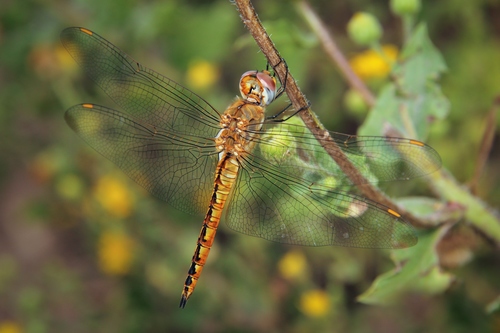
Wandering Glider
Pantala flavescens
Meet the world’s ultimate traveler: the Wandering Glider. This golden-winged dragonfly holds the record for the longest migration of any insect, crossing entire oceans to reach your backyard.
Quick Identification
Size
Body length: 45–50 mm (1.8–2 in); Wingspan: 72–84 mm (2.8–3.3 in)
Colors
Golden-yellow to honey-brown abdomen with a dark dorsal line; males often develop a reddish-orange tint at the tip of the tail.
Key Features
- Broad, triangular hind wings designed for long-distance gliding
- Golden-yellow to honey-brown abdomen with a thin black line down the center
- Large, reddish-brown eyes that meet at the top of the head
- Legs held in a basket shape during flight to catch prey
When You’ll See Them
Behavior
Known as the world's most widespread dragonfly, the Wandering Glider is a true marathon flyer. Unlike many dragonflies that defend a small territory near a pond, these "globe skimmers" use wind currents to travel thousands of miles across oceans. They are almost constantly in flight, rarely perching, and use their uniquely shaped wings to glide effortlessly with minimal energy. This allows them to stay airborne for hours, following weather fronts to find new breeding sites.
They are highly social and are often spotted in large feeding swarms, especially before a storm or during migration. Because they rely on temporary rain pools for breeding, they are "rain hunters," following seasonal weather patterns to find fresh water. They are harmless to humans and are actually quite beneficial, as they consume massive quantities of mosquitoes and gnats mid-air. Their ability to cross the Indian Ocean from India to Africa is one of the most remarkable feats in the natural world.
EverydayEarth exclusive
Camera Tips
Capturing the Wandering Glider on camera is a thrilling challenge because they spend significantly more time in the air than other dragonflies. To get the best shots, you should focus on their unique landing and "dipping" behaviors. Position your AI camera near flat, dark, reflective surfaces like a glass patio table, a dark-colored car hood, or a black plastic tray filled with water. These dragonflies use polarized light to find water sources, and they are often fooled by these man-made surfaces, which will bring them close enough to the lens for a clear identification.
Because these insects are incredibly fast, motion-trigger settings need to be optimized. Set your trail camera to its highest sensitivity and use a "Burst" or "Rapid-Fire" photo mode. If you are recording video, a high frame rate (60fps or higher) is essential to capture the detail of their transparent, broad hind wings without motion blur. Try to position your camera so it faces away from the sun (North or South) to ensure the golden-yellow color of the dragonfly is well-lit and vibrant, rather than being silhouetted against a bright sky.
Placement height is critical for this species. Unlike meadowhawks or skimmers that perch on low reeds, Wandering Gliders prefer to hover and glide 3 to 6 feet above the ground. Mount your camera on a tripod or fence post at chest height, overlooking an open lawn or a garden clearing. If you want to encourage them to stay in the frame, avoid tall, thick vegetation; they prefer "clear runways" for their aerial maneuvers. A shallow, dark-bottomed birdbath placed in the center of an open patch of your yard is the single most effective lure for this species.
Lastly, timing is everything. These "globe skimmers" are heat-seekers. Plan your camera deployments for calm, sunny days when the temperature rises above 75°F (24°C). They are particularly active just before a storm front moves in—a behavior that earned them the nickname "Rainpool Gliders." If you see high clouds moving in and the air feels humid, that is the peak time to ensure your camera batteries are fresh and your SD card is empty, as you might capture a feeding swarm of dozens of individuals at once.
Similar Species
Species that look similar or are commonly confused with Wandering Glider.
Frequently Asked Questions
Record Wandering Glider at your habitat
Connect a camera to start building your own species record — AI identifies every visitor automatically.