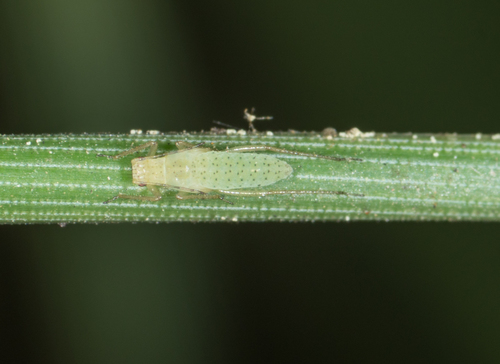
Spotted Green Pine Needle Aphid
Eulachnus agilis
Meet the sprinter of the insect world. The Spotted Green Pine Needle Aphid is a leopard-spotted speedster that brings a surprising amount of energy to the quiet world of backyard evergreens.
Quick Identification
Size
1.5 to 2.5 mm (0.06 to 0.1 inches) in length
Colors
Bright to pale green body covered in distinct dark brown or black spots; legs are long and yellowish-green
Key Features
- Elongated, narrow body shape compared to typical pear-shaped aphids
- Rows of dark spots across the abdomen
- Remarkably fast, running movement when disturbed
- Long, spindly legs adapted for navigating pine needles
When You’ll See Them
Behavior
Unlike most aphids that sit sedentary in large, crowded clumps, the Spotted Green Pine Needle Aphid is famously active. Its scientific name, agilis, perfectly describes its habit of sprinting away at the slightest hint of danger. They are often found living solitary lives or in very small groups, tucked neatly against the length of a pine needle where their green coloration provides excellent camouflage.
These aphids are phloem feeders, but they are picky eaters, favoring the needles of specific pine species. While they do excrete honeydew, they aren't always as heavily attended by ants as other aphid species because their speed allows them to escape many predators without a bodyguard. They spend their days moving between needles, seeking the most nutrient-rich sap while avoiding the direct heat of the midday sun.
EverydayEarth exclusive
Camera Tips
Capturing the Spotted Green Pine Needle Aphid requires a specialized approach because of their minuscule size and skittish nature. To get a usable image or video, you will need a dedicated macro lens or a high-quality macro attachment for your trail camera. Position your camera just 2 to 4 inches away from a cluster of healthy green pine needles, specifically focusing on the previous year's growth rather than the brand-new tender tips, as these aphids prefer the established needles.
Lighting is the most critical factor for success. Because these insects are translucent and small, flat light will make them disappear against the green background. Use an off-camera LED light source or a small reflector to create side-lighting. This will catch the 'glow' of their green bodies and make the dark spots and tiny hairs (setae) stand out. If your camera allows for manual focus, set it to a fixed point and wait for the aphids to move into the frame; autofocus often struggles with the thin profile of pine needles.
Because these aphids are 'agile,' they move quickly enough to cause motion blur in low light. Set your camera to a fast shutter speed or a high frame rate (at least 60fps) to freeze their movement. If you are using an AI-triggered camera, you may find that the motion of the insect is too small to trigger the sensor. In this case, use a time-lapse mode set to take a photo every 10 to 30 seconds. This 'sit and wait' approach is often the best way to document their behavior without scaring them away with your presence.
Check for the presence of ants or 'sooty mold' (a black fungus that grows on honeydew) on your pine trees first. These are the best indicators that a colony is nearby. Once you find a tree with activity, look for needles that appear slightly yellowed or mottled, as these are the ones currently being fed upon. Secure your camera mount to a sturdy branch to prevent wind-sway, which is the number one cause of ruined macro footage in the backyard.
Similar Species
Species that look similar or are commonly confused with Spotted Green Pine Needle Aphid.
Frequently Asked Questions
Record Spotted Green Pine Needle Aphid at your habitat
Connect a camera to start building your own species record — AI identifies every visitor automatically.