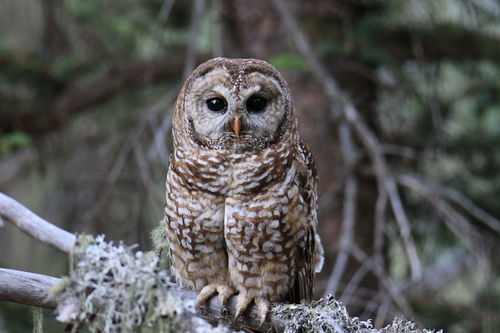
Spotted Owl
Strix occidentalis
The Spotted Owl is the silent guardian of the West's ancient forests. With its iconic dark eyes and intricate spotted plumage, this rare bird is a symbol of wild, untouched wilderness.
Quick Identification
Size
Length of 16 to 19 inches (40-48 cm), a wingspan of approximately 42 inches (107 cm), and a weight between 1.1 and 1.7 lbs (500-770 g).
Colors
Mottled dark brown plumage with distinctive white oval spots on the head, back, and chest. They possess deep, dark brown eyes and a pale yellowish-green bill.
Key Features
- Large, dark soulful eyes with no yellow iris
- Distinctive white oval spots on breast and belly plumage
- Large rounded head without ear tufts
- Pale brown facial disk with dark concentric circles
When You’ll See Them
Behavior
The Spotted Owl is a master of the deep forest, known for its quiet and unassuming presence. Unlike the more aggressive Barred Owl, this species is relatively sedentary and shy, often remaining in the same small territory for its entire adult life. They are strictly nocturnal, spending their daylight hours roosting in the cool, dense shade of the forest canopy or nestled against the trunks of ancient trees to avoid heat and predators.
As "sit-and-wait" predators, they spend much of their night perched on low branches, using their incredible hearing and low-light vision to scan the forest floor for movement. They are highly territorial during the breeding season but rarely interact with humans due to their preference for secluded, mature forests. Their social life is built on long-term pair bonds; once a pair is established, they typically remain together for life, nesting in the same general area year after year.
EverydayEarth exclusive
Camera Tips
Capturing a Spotted Owl on a trail camera is a badge of honor for any wildlife enthusiast. Because they are shy and prefer deep forest interiors, camera placement is everything. Look for areas with "old-growth characteristics": large-diameter trees, fallen logs, and a dense overhead canopy. Identify potential roosting spots by looking for "whitewash" (droppings) or owl pellets at the base of large conifers. Position your camera 10 to 15 feet up a neighboring tree using a climbing bracket, angling it downward toward a suspected perch or a natural forest opening where they might dive for prey.
Since Spotted Owls are strictly nocturnal, your camera’s flash technology is critical. We recommend using "No-Glow" or Black IR LEDs. Standard "Low-Glow" infrared can sometimes emit a faint red light that may startle these sensitive birds or, more importantly, attract the attention of their more aggressive competitors, the Barred Owl. Set your camera to a high-sensitivity trigger with a fast shutter speed (0.3 seconds or less) to capture the owl in flight. Using "Burst Mode" to take 3-5 photos per trigger will increase your chances of getting a clear shot of their distinctive spotted chest patterns.
In late spring and early summer, parents are at their most active as they hunt to feed growing owlets. If you have a permanent water source like a small creek or a hidden spring on your property near a wooded area, this is a prime location for a camera. Spotted Owls will often descend to drink or bathe during the hot summer months. Because these birds are federally protected and sensitive to disturbance, always check your cameras quickly and infrequently—no more than once every two to three weeks—to ensure you aren't stressing the pair or leading predators to their nesting site.
Similar Species
Species that look similar or are commonly confused with Spotted Owl.
Barred Owl
Features vertical brown 'bars' on its belly instead of spots and is slightly larger and more aggressive.
Great Horned Owl
Has prominent ear tufts and bright yellow eyes, whereas the Spotted Owl has a rounded head and dark eyes.
Flammulated Owl
Also has dark eyes but is much smaller (about the size of a sparrow) and primarily eats insects.
Frequently Asked Questions
Record Spotted Owl at your habitat
Connect a camera to start building your own species record — AI identifies every visitor automatically.