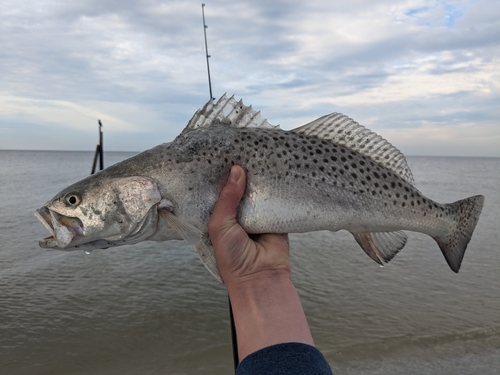
Spotted Seatrout
Cynoscion nebulosus
Often called the 'Speckled Trout,' this iridescent predator is a master of the salt marsh. With its striking spots and twin fangs, it is one of the most iconic and beautiful fish found in the coastal waters of the southern United States.
Quick Identification
Size
19–37 inches (48–94 cm) in length; 3–17 pounds (1.4–7.7 kg) in weight.
Colors
Silvery body with dark, iridescent greenish or gray reflections on the back; numerous small black spots on the back, dorsal fin, and tail; white underside.
Key Features
- Distinct black spots on the back and tail
- Two large, fang-like canine teeth in the upper jaw
- Silvery-white belly with an iridescent upper body
- Elongated, streamlined shape
- Yellow interior of the mouth
When You’ll See Them
Behavior
Spotted seatrout are highly active predators that primarily inhabit the shallow, brackish waters of estuaries and lagoons. They are opportunistic hunters, often lurking near the edges of seagrass beds or oyster reefs to ambush passing prey. While younger fish tend to congregate in large schools for protection, larger "trophy" trout (often called 'gator trout') are more solitary and prefer to hunt alone in deeper holes or under the cover of darkness.
These fish are known for their sensitivity to water temperature and salinity. During the hot summer months, they are most active in the early morning or at night when the water is cooler. In the winter, they migrate toward deeper coastal rivers or industrial warm-water discharges to seek thermal refuge. They communicate using their swim bladders to create a distinctive drumming sound, a behavior most prominent among males during the spring and summer spawning seasons.
EverydayEarth exclusive
Camera Tips
Capturing the spotted seatrout on an underwater camera requires a focus on "structure." These fish are rarely found in open, featureless water. To get the best footage, mount your camera using a weighted base or a pier-clamp near oyster reefs, dock pilings, or the edges of seagrass beds. Position the lens about 12 to 18 inches off the bottom, angled slightly upward to capture the silvery silhouettes of trout as they cruise through the mid-water column. Clear water is essential for high-quality daytime footage, so aim to record during an incoming tide when cleaner ocean water pushes into the estuaries.
Nighttime is perhaps the most exciting time to monitor seatrout. If you have access to a dock with underwater lights, place your camera just on the edge of the light's radius. Seatrout often hang back in the shadows, darting into the light to snatch baitfish. If using an AI-powered camera with infrared (IR) capabilities, ensure you have a stable mounting point, as seatrout are easily spooked by vibrating cables or moving equipment. Using a mesh bag filled with crushed crab or shrimp as a lure can draw in baitfish, which will naturally attract the seatrout into your camera's field of view.
For the most professional-looking footage, set your camera to a high frame rate (60fps or higher). Seatrout strikes are incredibly fast—literally a 'flash' of silver—and slow-motion playback is often the only way to see their specialized canine teeth in action as they grab prey. During the winter, look for deeper 'holes' in canals or coastal creeks where trout stack up to stay warm; a camera dropped into these depressions can capture dozens of fish huddled together in a dormant state.
Similar Species
Species that look similar or are commonly confused with Spotted Seatrout.
Frequently Asked Questions
Record Spotted Seatrout at your habitat
Connect a camera to start building your own species record — AI identifies every visitor automatically.