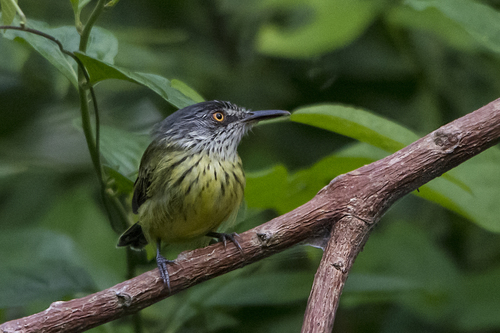
Spotted Tody-Flycatcher
Todirostrum maculatum
A tiny dynamo of the tropical canopy, the Spotted Tody-Flycatcher is easily recognized by its heavy breast streaks and rhythmic tail wags. This active little bird turns every garden thicket into a high-speed hunting ground.
Quick Identification
Size
9–10 cm (3.5–4 in) long; weight approximately 7–10 g (0.25–0.35 oz)
Colors
Olive-green upperparts, bright yellow belly, and a white throat and breast covered in heavy black vertical streaks. Wings are dark with yellow-edged feathers.
Key Features
- Large, flattened 'tody-like' black bill
- Distinctive black vertical streaks on a white breast
- Pale yellowish-white iris
- Often cocks and wags its tail from side to side
When You’ll See Them
Behavior
The Spotted Tody-Flycatcher is a restless and energetic bird that brings a sense of constant motion to the garden. Unlike many flycatchers that sit still and wait for prey, this species is perpetually on the move, hopping through dense foliage and vine tangles. They are most often seen in pairs, communicating with a series of sharp, rhythmic 'tick' notes as they forage for insects together.
One of their most characteristic behaviors is their tail movement. They often hold their tails at an upward angle and flick them side-to-side in a wagging motion. While they can be bold when defending their territory from other small birds, they generally remain hidden within the leaves, making their presence known more through their mechanical, trilling songs than by sitting out in the open.
EverydayEarth exclusive
Camera Tips
To successfully capture the Spotted Tody-Flycatcher on an AI-powered camera, placement is the most critical factor. These birds rarely spend time on the ground, so you should mount your camera at a height of 5 to 8 feet. Look for 'corridors' of vegetation—areas where two shrubs nearly touch or where vines hang down—as they love to use these as leafy highways. Positioning the camera near a water feature or a dripping birdbath is also a winning strategy, as they frequently visit water to bathe and drink.
Because the Spotted Tody-Flycatcher is so small and fast, motion blur is a common challenge. If your camera settings allow, prioritize a fast shutter speed. The bird’s most identifying feature is the streaking on its breast; to capture this clearly, try to angle your camera so it faces a spot that receives bright, indirect sunlight. Harsh, direct midday sun can wash out the yellow of their belly and make the streaks harder to distinguish in a digital capture.
If you want to encourage them to visit a specific branch in front of your camera lens, avoid traditional birdseed, which they won't eat. Instead, maintain a garden with native, nectar-rich flowers that attract the small gnats and flies they prey upon. A 'wild' corner of the yard with some leaf litter and dense twigs will provide the perfect hunting ground that these flycatchers can't resist exploring.
Similar Species
Species that look similar or are commonly confused with Spotted Tody-Flycatcher.
Frequently Asked Questions
Record Spotted Tody-Flycatcher at your habitat
Connect a camera to start building your own species record — AI identifies every visitor automatically.