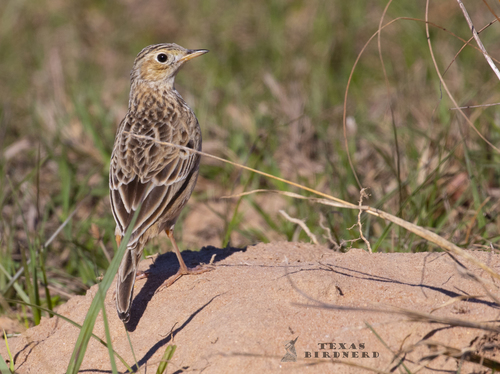
Sprague's Pipit
Anthus spragueii
A master of the open skies and hidden grasses, Sprague's Pipit is the elusive ghost of the North American prairie, known for its shimmering song delivered from the clouds.
Quick Identification
Size
Length: 15–17 cm (5.9–6.7 in); Wingspan: 23–25 cm (9–10 in); Weight: 22–26 g (0.8–0.9 oz)
Colors
Cryptic buffy-brown upperparts with heavy dark streaking; pale buff underparts with a necklace of fine streaks on the breast; white outer tail feathers; pinkish-yellow legs; males and females look identical.
Key Features
- Slender, pinkish to yellowish legs
- Distinctive white outer tail feathers visible in flight
- Thin, pointed bill with a pale base
- Cryptic, streaked brown plumage that blends into dry grass
- Extraordinary high-altitude flight display and descending song
When You’ll See Them
Geographic range
Where Does the Sprague's Pipit Live?
The Sprague's Pipit is a specialist of the North American Great Plains, relying almost exclusively on native prairie landscapes. Its breeding grounds are concentrated in the northern heartland of the continent, spanning from the Canadian provinces of Alberta, Saskatchewan, and Manitoba down into the northern United States, particularly North Dakota, Montana, and South Dakota. As winter approaches, these birds journey south to find refuge in the grasslands of the southwestern United States—primarily Texas and Louisiana—and the arid plateaus of Northern and Central Mexico.
Basemap © OpenStreetMap contributors
Behavior
Sprague's Pipit is often called the 'Skylark of the Prairies' because of its unique aerial display. Unlike most songbirds that sing from a conspicuous perch, the male Sprague’s Pipit ascends hundreds of feet into the air—sometimes becoming a mere speck to the naked eye—to deliver a shimmering, descending song that can last for hours. This behavior is a primary way to locate them, as they are notoriously difficult to spot while on the ground.
When not in the air, this species is a master of concealment. It spends its time walking or running through dense grass rather than hopping. If approached, it usually crouches low and stays still until the very last second, eventually flushing in a zig-zag flight pattern before dropping back into cover. They are generally solitary during the breeding season but may form loose flocks during migration and winter.
EverydayEarth exclusive
Camera Tips
Capturing a Sprague's Pipit on camera requires a different strategy than your typical backyard feeder bird. Because they are ground-dwellers that strictly avoid perches, your camera should be mounted very low to the ground—no higher than 6 to 12 inches. Angle the lens slightly upward or keep it level with the grass line. Avoid placing cameras near tall trees or thickets, as these birds actively avoid areas where predators might lurk. Instead, look for open patches within native grass stands where the vegetation is relatively short or has been lightly grazed.
Since they do not visit standard bird feeders, the best way to lure them into frame is to provide a very shallow, ground-level water source. A simple basin or even a shallow depression in the soil lined with a waterproof film can be highly effective, especially in drier prairie environments. Ensure the area around the water is clear of tall weeds for at least a few feet to make the bird feel safe from ambush while drinking or bathing.
Set your AI camera to a high-sensitivity motion trigger and a fast shutter speed. These birds move with a quick, jerky walk and can be easily blurred in low-light conditions. Because their plumage is designed to blend perfectly with dried grass, use a camera with a high-resolution sensor and try to position it so the morning or late afternoon sun is at your back. This side-lighting helps to highlight the texture of their streaked feathers, making them stand out from the background.
Patience is key with this species. They are sensitive to human presence and changes in their environment. Once you place your camera, leave it undisturbed for at least a week to allow the birds to become accustomed to the new object. If your camera has audio recording capabilities, keep it enabled; the tinkling, descending song is a foolproof way to confirm their presence even if they are just out of the frame.
Similar Species
Species that look similar or are commonly confused with Sprague's Pipit.
American Pipit
Darker legs and less streaking on the back; often found near water or mudflats.
Savannah Sparrow
A thicker, sparrow-like bill and often shows a yellow wash near the eye; shorter tail.
Horned Lark
Bolder facial pattern with a black 'mask' and 'horns' (feather tufts); lacks the fine streaking of the pipit.
Frequently Asked Questions
Record Sprague's Pipit at your habitat
Connect a camera to start building your own species record — AI identifies every visitor automatically.