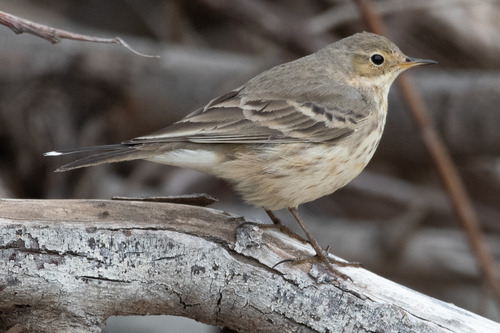
American Pipit
Anthus rubescens
A hardy world-traveler that bobs its way across the tundra and the plains. Look for the American Pipit's distinctive walk and wagging tail in your local open fields this winter.
Quick Identification
Size
Length: 15–17 cm (6–6.7 in) | Wingspan: 27 cm (10.6 in) | Weight: 15–25 g (0.5–0.9 oz)
Colors
Gray-brown to olive upperparts, buff-colored breast with dark streaking, dark legs, and white outer tail feathers visible during flight.
Key Features
- Constant rhythmic tail-bobbing while walking
- Slender, dark bill for insect-eating
- White outer tail feathers
- Walks instead of hopping on the ground
When You’ll See Them
Geographic range
Where Does the American Pipit Live?
Native to the North American continent, the American Pipit is a hardy traveler with a massive geographic footprint. Its breeding grounds are located in the high Arctic tundra of Canada and Alaska, as well as on high-elevation mountain peaks in the western United States. When the cold sets in, they migrate south to occupy nearly the entire United States, Mexico, and northern Central America, where they frequent lowland open spaces. This species also has a significant presence in Eastern Asia, with populations that winter as far south as Southeast Asia.
Basemap © OpenStreetMap contributors
Behavior
The American Pipit is a master of the ground, distinguished by its unique habit of constantly bobbing its tail up and down as it walks. Unlike many songbirds that hop, the pipit moves with a graceful, rhythmic stride, scouring open soil and short grass for food. During the breeding season, they are found in the harsh conditions of the high tundra, but in the winter, they form large, loose flocks that can be seen in fields, mudflats, and coastal areas.
These birds are generally shy around humans and will take flight in a zigzagging pattern if startled, often letting out a sharp 'pip-it' call that gives them their name. They are highly social during migration and winter, often foraging alongside Horned Larks and Longspurs. Their social structure is loose, but they rely on the 'safety in numbers' strategy when feeding in the wide-open, exposed habitats they prefer.
EverydayEarth exclusive
Camera Tips
To capture the American Pipit on camera, you must focus on the ground. These birds rarely perch in trees, preferring open, flat terrain with minimal vegetation. Place your AI-powered camera on a low tripod or directly on the ground (using a weather-sealed housing) near the edge of a mudflat, a recently plowed field, or a short-grass patch. Angle the lens slightly upward to catch their profile and the characteristic tail-bobbing motion against the horizon.
While they don't typically visit traditional bird feeders, you can attract them to a camera site by providing a shallow ground-level birdbath or a solar-powered dripper. Pipits are highly attracted to the sound of moving water, especially in arid or agricultural environments. If you are in a rural area, placing a camera near a small puddle in a gravel driveway or a damp depression in a field is a high-probability setup.
Because pipits are active during the brightest parts of the day, ensure your camera's shutter speed is high to freeze their rapid movements and zigzagging flight. They are most active in the morning hours as they forage for insects. In the winter, look for 'scout' birds; if one lands in an open area, a flock of fifty may follow. Setting your camera to 'burst mode' or high-frequency triggers will help capture the social dynamics of the flock.
Similar Species
Species that look similar or are commonly confused with American Pipit.
Water Pipit
Found primarily in Europe and Asia; American Pipits have darker legs and more buff-colored underparts.
Horned Lark
Shares the same open-field habitat but has a bold black facial mask and 'horns' which the pipit lacks.
Sprague's Pipit
Has lighter, flesh-colored legs and more distinct streaking on its back compared to the American Pipit's dark legs.
Frequently Asked Questions
Record American Pipit at your habitat
Connect a camera to start building your own species record — AI identifies every visitor automatically.