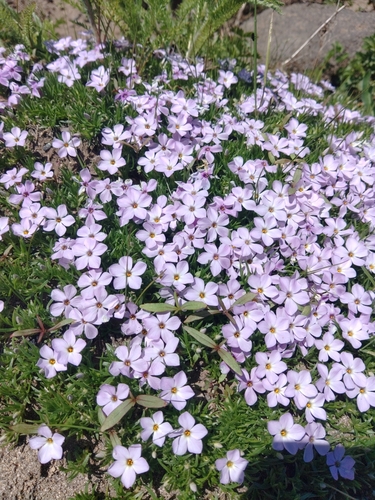
spreading phlox
Phlox diffusa
A resilient mountain gem that carpets the western wilderness in a tapestry of lavender and white blossoms.
Quick Identification
Size
Low-growing mats 5-10 cm (2-4 in) tall; individual flowers 1-2 cm (0.4-0.8 in) wide
Colors
Petals vary from brilliant white and pale lavender to soft pink or light blue; foliage is a dusty, greyish-green.
Key Features
- Dense, carpet-like growth habit
- Needle-like, stiff leaves under 1.5 cm long
- Five-lobed tubular flowers with flat, overlapping petals
- Woody base with decumbent (lying on ground) stems
When You’ll See Them
Geographic range
Where Does the spreading phlox Live?
Spreading phlox is a quintessential wildflower of Western North America, stretching from the rugged mountains of British Columbia and Alberta down through the Pacific Northwest into California and the Southwestern United States. It extends as far east as the Dakotas and Nebraska, often found clinging to sun-drenched, high-altitude slopes. While it is most famous for its presence in the Cascades and the Sierra Nevada, it is a resilient resident of many montane environments across the western half of the continent.
Basemap © OpenStreetMap contributors
Behavior
Spreading phlox is a hardy, mat-forming perennial that thrives in harsh, well-drained environments. Unlike taller garden varieties, this species hugs the ground to protect itself from high mountain winds and to conserve moisture. During the early spring and summer months, it undergoes a dramatic transformation, covering its needle-like foliage with a profusion of sweet-scented blossoms that can turn a rocky slope into a carpet of color.
As a key player in its ecosystem, spreading phlox acts as a vital early-season nectar source. It has a symbiotic relationship with various long-tongued insects. Because the nectar is tucked deep within the floral tube, the plant specifically caters to butterflies and day-flying moths. In suburban or trail settings, it is often seen "hugging" the edges of rocks, using them as heat sinks to stay warm during cold alpine nights.
EverydayEarth exclusive
Camera Tips
Capturing the beauty of spreading phlox requires a ground-level approach. Because these plants form dense mats only a few inches high, you should position your camera on a low-profile tripod or directly on a flat stone. Aim for a 45-degree angle to capture both the intricate needle-like texture of the leaves and the flat face of the blossoms. To get the best results, use a macro lens or a camera with a close-focusing distance of at least 10-15 centimeters.
While the plant itself is stationary, the real action for AI-powered cameras happens with its visitors. Set your camera to a high-speed trigger mode during the midday sun. Spreading phlox is a magnet for swallowtail butterflies, clearwing moths, and bees. By focusing on a particularly dense patch of flowers, you can capture stunning wildlife interactions. If your camera supports time-lapse, set it to take a photo every 30 minutes over a week in late spring to document the "carpet effect" as the buds explode into full bloom.
Lighting is crucial for this species. The pale petals can easily wash out in harsh, direct noon sunlight. The best "golden hour" for phlox is actually mid-morning, when the dew might still be on the needles but the sun is high enough to illuminate the throat of the flower. If you are placing a camera in a backyard rock garden, ensure the area is clear of tall grass that might blow in front of the lens and cause false triggers. No bait is needed for this species, as its natural fragrance and nectar are the primary lures for the local insect population.
Similar Species
Species that look similar or are commonly confused with spreading phlox.
Frequently Asked Questions
Record spreading phlox at your habitat
Connect a camera to start building your own species record — AI identifies every visitor automatically.