Squirrel's Tail
Justicia betonica
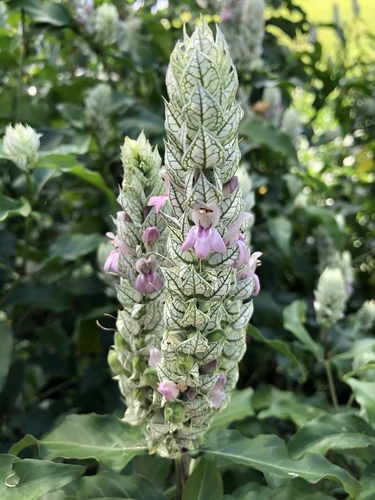
A striking tropical shrub famous for its white and green-veined flower spikes that mimic the fluffy tail of a squirrel. It is a powerhouse for biodiversity, acting as a top-tier nectar source for butterflies and hummingbirds.
Quick Identification
Size
Grows as an upright shrub typically reaching 1 to 2 metres (3 to 6 feet) in height, with flower spikes 10 to 15 cm (4 to 6 inches) long.
Colors
White bracts with prominent green veins; small, inconspicuous white flowers with mauve or purple spots.
Key Features
- Upright flower spikes resembling a bushy squirrel's tail
- Papery white bracts with distinct green 'net' veining
- Opposite, oval-shaped dark green leaves with pointed tips
- Small two-lipped white flowers that emerge from between the bracts
When You’ll See Them
Geographic range
Where Does the Squirrel's Tail Live?
The Squirrel's Tail is native to the tropical landscapes of Africa and the Indian Subcontinent, thriving across regions like Kenya, Ethiopia, India, and Sri Lanka. It has since expanded its footprint significantly, becoming naturalized in tropical locales such as Hawaii, Florida, and various Caribbean islands. Today, it is a common sight in sunny suburban gardens and disturbed forest edges throughout the global tropics and subtropics.
Basemap © OpenStreetMap contributors
Behavior
Squirrel's Tail is a perennial evergreen shrub known for its architectural beauty and its role as a cornerstone of the pollinator garden. Unlike many flowering plants that bloom in short bursts, this species can produce its distinctive 'tails' year-round in frost-free climates. It grows in an upright, somewhat leggy fashion, often forming dense clumps that provide excellent low-level cover for small garden creatures.
In the wild and in backyards, its primary 'behavior' is its constant interaction with wildlife. It is a high-reward nectar source that attracts a revolving door of visitors. While the plant itself is stationary, it functions as a social hub for the local ecosystem, often becoming the site of territorial disputes between hummingbirds or a primary refueling station for migrating butterflies.
EverydayEarth exclusive
Camera Tips
Capturing the Squirrel's Tail on a backyard camera requires a focus on the pollinators it attracts rather than the plant itself. Position your camera on a tripod or mount at a height of 3 to 4 feet, directly level with the most mature flower spikes. An angled shot from slightly above can help capture the intricate green-veined patterns of the bracts while also recording the entry of bees and butterflies into the flower tubes.
Because plants don't trigger PIR (Passive Infrared) sensors, you have two options for great footage. Either use a camera with a 'Time Lapse' mode set to take a photo every 30 seconds during daylight hours, or increase your PIR sensitivity to its highest setting to catch the rapid movement of visiting hummingbirds or large butterflies. If your camera allows, a high-speed video setting (60fps or higher) is ideal for slowing down the wing beats of the insects and birds that frequent these blooms.
Lighting is crucial for this species; the white bracts can easily 'blow out' and look like white blobs in harsh midday sun. Set your camera to face North or South to avoid direct lens flare, and you'll find that the 'Golden Hour'—just after sunrise or before sunset—provides the best contrast to show off the green veining. If you are using a trail camera with a macro lens attachment, this is the perfect subject for close-up insect photography.
Similar Species
Species that look similar or are commonly confused with Squirrel's Tail.
Frequently Asked Questions
Record Squirrel's Tail at your habitat
Connect a camera to start building your own species record — AI identifies every visitor automatically.