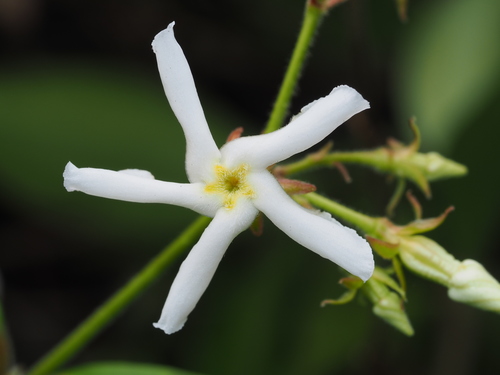
Star jasmine
Trachelospermum jasminoides
A fragrant masterpiece of the backyard, Star Jasmine is an evergreen climber that provides year-round shelter for birds and an irresistible nectar source for butterflies and moths.
Quick Identification
Size
A woody climbing vine reaching 3 to 9 metres (10 to 30 feet) in length, with leaves 5 to 10 cm (2 to 4 inches) long.
Colors
Glossy dark green foliage that may turn bronze-red in cold weather; flowers are creamy white to pale yellow.
Key Features
- Five-petaled white flowers shaped like tiny stars or pinwheels
- Opposite, oval-shaped leathery evergreen leaves
- Twining woody stems that exude a milky sap when cut
- Intense, sweet fragrance especially prevalent in evening
- Dense, mat-forming growth habit ideal for vertical cover
When You’ll See Them
Geographic range
Where Does the Star jasmine Live?
Star jasmine is native to the subtropical regions of eastern and southeastern Asia, with its ancestral home stretching across China, Japan, Korea, and Vietnam. Because of its extreme popularity as an ornamental, it has become widely naturalized across the southern United States (from California to Florida), Mediterranean Europe, and parts of Australia. It thrives in humid, temperate to subtropical climates, typically flourishing in hardiness zones 8 through 10, where it can be found draping over everything from garden walls to highway medians.
Basemap © OpenStreetMap contributors
Behavior
Star jasmine is a vigorous evergreen climber known for its twining stems that wrap around supports like trellises and fences without the need for adhesive tendrils. While it starts with a relatively slow growth rate during its first year, it quickly establishes itself as a dominant landscape feature, creating a dense wall of greenery. Its most famous behavior is the massive flush of blooms that occurs in late spring, during which the plant produces thousands of star-shaped flowers that release a heavy, honey-like perfume detectable from several dozen feet away.
For backyard wildlife, the behavior of this plant is primarily structural. It creates a complex, multi-layered habitat that remains green year-round. Small songbirds often use the interior of a mature star jasmine vine as a safe 'staging area' before visiting feeders, or even as a secure nesting site protected from the wind and predators. In many urban environments, it acts as a critical wildlife corridor, allowing small reptiles and insects to move through gardens while staying hidden from sight.
EverydayEarth exclusive
Camera Tips
To capture the best wildlife action on your star jasmine, position your camera at eye level with the blooming clusters. This plant is a magnet for pollinators, especially hummingbird moths, swallowtail butterflies, and various species of bees. Use a camera with a fast trigger speed or a macro-focusing mode to catch these insects in mid-air as they hover near the nectar-rich blooms. Early morning light provides the best illumination for the white flowers, which can otherwise appear 'blown out' or overexposed in the harsh midday sun.
Because the foliage is so dense, star jasmine often serves as a hidden highway for small mammals and reptiles. Try mounting a camera low to the ground, angled along the base of a jasmine-covered fence. This is a prime location to catch shy species like anoles, skinks, or even foraging opossums and raccoons that use the vine as a visual shield while moving through your yard. If you notice birds frequently diving into the foliage, there may be a nest inside; keep your camera at a respectful distance and use a zoom lens to observe the activity without disturbing the parents.
Seasonal timing is key for this species. During the peak bloom in late spring, set your camera to take short video clips rather than just stills to capture the movement of the many pollinators. In the winter, the plant remains evergreen, making it one of the few places in your backyard that will show up as vibrant green on camera. Use this to your advantage by placing a birdbath or feeder near the jasmine; the contrast of a colorful bird like a Cardinal against the dark green leaves makes for stunning, professional-looking backyard photography.
Similar Species
Species that look similar or are commonly confused with Star jasmine.
Frequently Asked Questions
Record Star jasmine at your habitat
Connect a camera to start building your own species record — AI identifies every visitor automatically.