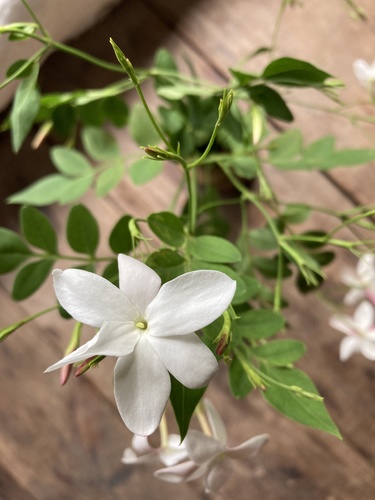
Common Jasmine
Jasminum officinale
The Common Jasmine is the crown jewel of the fragrant garden, a vigorous climber that fills the summer night with its legendary perfume. Known for its delicate white stars and lush green vines, it is a haven for pollinators and a favorite for backyard observers.
Quick Identification
Size
A vigorous climber reaching 4–8 metres (13–26 feet) in height with a spread of 2–5 metres (6–16 feet).
Colors
Deep green foliage; pure white star-shaped flowers, occasionally with a pinkish tint on the outer buds.
Key Features
- Strongly fragrant white star-shaped flowers
- Vining, climbing habit with slender green stems
- Opposite, pinnate leaves with 5-9 leaflets
- Terminal clusters of 3-9 blooms
When You’ll See Them
Geographic range
Where Does the Common Jasmine Live?
Common Jasmine is native to the vast region spanning from the Caucasus through northern Iran, Afghanistan, and the Himalayas into western China. Because of its legendary fragrance, it has been cultivated for centuries and is now widely naturalized across the Mediterranean basin, Southern Europe, and parts of the southern United States. It thrives in temperate and subtropical zones where it can find sufficient support to climb and plenty of sunlight to fuel its blooms.
Basemap © OpenStreetMap contributors
Behavior
Common Jasmine is a deciduous or semi-evergreen perennial known for its rapid growth and climbing prowess. Unlike animals that move through space, this plant 'behaves' through its growth patterns, using twining stems to ascend trellises, fences, or larger trees. Its most famous behavior is its scent production; the plant releases an intense, sweet fragrance that peaks in concentration during the night to attract nocturnal pollinators like hawk moths.
In a backyard ecosystem, Jasmine serves as a vital structural element and a food source. It provides dense cover for small birds to nest and hide from predators. While it is generally non-aggressive, it can become quite dense if left unpruned, creating a mini-microclimate of humidity and shade beneath its canopy that supports various beneficial insects and soil organisms.
EverydayEarth exclusive
Camera Tips
To capture the true life of Common Jasmine, you should focus your camera on the flower clusters rather than the entire vine. Position your AI-powered camera approximately 12–24 inches from a fresh cluster of buds. Because Jasmine flowers are brilliant white, they can easily 'blow out' or overexpose in direct sunlight. Try to angle the camera so the flowers are side-lit during the golden hour, or use a camera with high dynamic range (HDR) settings to preserve the delicate petal details.
Since the most exciting 'wildlife' action around Jasmine happens after dark, ensure your camera's infrared (IR) or night-vision mode is optimized. Jasmine is a magnet for Sphinx moths (hawk moths), which hover like hummingbirds to drink nectar. To catch these fast-movers, use a high shutter speed if your camera allows it, or set your AI trigger sensitivity to high. The motion of a large moth hovering in front of a white flower is a classic 'money shot' for backyard naturalists.
Time-lapse is your best friend when documenting the plant itself. Set your camera to take a photo every 15–30 minutes over a period of several days as the buds transition from pinkish-white tips to full, star-shaped blooms. You will notice the flowers actually move and adjust their orientation slightly to maximize sun exposure and pollinator access.
Don't forget the ground-level perspective. The dense foliage of Jasmine often hosts spiders, predatory insects, and even small tree frogs. Placing a camera at the base of the vine or looking 'up' through the leaves can reveal a hidden world of garden activity that occurs under the cover of the jasmine's thick canopy.
Similar Species
Species that look similar or are commonly confused with Common Jasmine.
Star Jasmine
Leathery, simple leaves and milky sap; actually a member of the Apocynaceae family, not a true jasmine.
Winter Jasmine
Bright yellow flowers that bloom in late winter on leafless green stems; lacks the signature fragrance of Common Jasmine.
Arabian Jasmine
More shrub-like with rounded, simple leaves and exceptionally thick, waxy petals; typically has a more tropical growth habit.
Frequently Asked Questions
Record Common Jasmine at your habitat
Connect a camera to start building your own species record — AI identifies every visitor automatically.