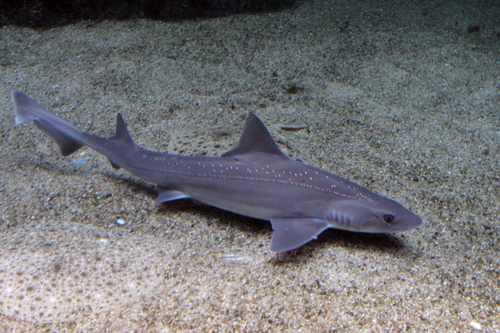
Starry Smooth-hound
Mustelus asterias
The Starry Smooth-hound is a graceful, spotted wanderer of the Atlantic's coastal shallows. Recognizable by its 'star-dusted' back and gentle nature, this crab-hunting specialist is a favorite for underwater explorers.
Quick Identification
Size
Typically 100–140 cm (3.3–4.6 ft) in length; weight usually ranges from 5–13 kg (11–28 lbs).
Colors
Greyish-brown or olive-grey back peppered with numerous small, distinct white spots; belly is a contrasting creamy white.
Key Features
- Distinctive white 'starry' spots scattered across the dorsal side
- Two large dorsal fins of roughly equal size without defensive spines
- Short, blunt snout with a mouth containing flat, crushing plates
- Slender, streamlined shark profile with large, cat-like eyes
When You’ll See Them
Behavior
The Starry Smooth-hound is a social and migratory species of houndshark that favors the coastal waters of the Northeast Atlantic. Unlike the more aggressive reputation of their larger cousins, these sharks are quite docile and spend much of their time cruising the seabed in search of prey. They are known to form loose schools, particularly during the summer months when they move into shallower inshore waters to feed and give birth to live young.
These sharks are highly adapted for bottom-dwelling life. Instead of the sharp, pointed teeth seen in many sharks, the Starry Smooth-hound possesses rows of flattened grinding plates. This 'smooth' dentition is perfectly designed for crushing the hard shells of crabs and lobsters. To humans, they are entirely harmless and are often a thrill for coastal observers or divers who catch a glimpse of them gliding over sandy or gravelly bottoms.
EverydayEarth exclusive
Camera Tips
Capturing the Starry Smooth-hound requires a specialized approach since they are entirely aquatic. If you have a 'backyard' that borders a pier, jetty, or a shallow bay, an underwater action camera or a submerged trail camera is your best tool. Mount your camera to a weighted base or a pier piling, positioning it about 12 to 18 inches above the seabed. Aim the lens horizontally across a sandy clearing—these sharks prefer open 'highways' between kelp forests or rocky reefs.
To guarantee a sighting, use a scent lure. A mesh chum bag filled with crushed oily fish (like mackerel or herring) or smashed green crabs is irresistible to them. Secure the bait bag roughly 3 to 5 feet in front of the lens. The Starry Smooth-hound has an incredible sense of smell and will follow the scent trail directly to your camera. Ensure the bait is positioned so the shark must pass through the frame to reach it, rather than hovering directly on top of the lens.
Lighting is the biggest challenge underwater. While these sharks are most active at dawn and dusk, the best footage often comes from midday when natural light penetrates the water column. If filming at night, use high-intensity infrared or a diffused red LED light to avoid 'spooking' the fish. Standard white lights can sometimes cause the shark to flee or result in 'backscatter' where the light reflects off particles in the water, obscuring the subject.
Pay close attention to the tides. The hour surrounding high tide is often the most productive, as the increased water depth encourages the sharks to move closer to the shore. Additionally, 'slack water' (the period when the tide isn't moving) results in less silt and debris being kicked up, giving you the clearest possible image. Always double-check the waterproof seals on your camera housing and use a tether line to ensure your equipment doesn't get swept away by a strong current.
Similar Species
Species that look similar or are commonly confused with Starry Smooth-hound.
Frequently Asked Questions
Record Starry Smooth-hound at your habitat
Connect a camera to start building your own species record — AI identifies every visitor automatically.