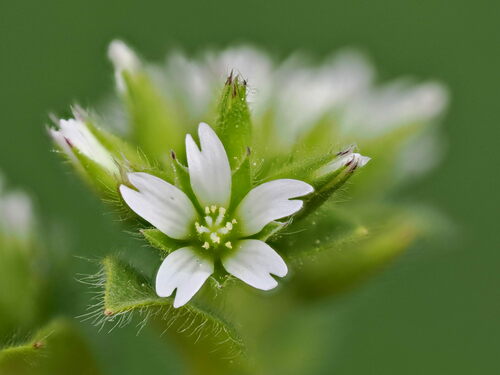
Sticky mouse-ear chickweed
Cerastium glomeratum
A fuzzy, resilient harbinger of spring, Sticky mouse-ear chickweed brings life to garden borders with its tiny white stars and unique, velvet-like texture.
Quick Identification
Size
Stems typically reach 5–45 cm (2–18 inches) in height, often growing in upright or sprawling clumps.
Colors
Pale to medium green foliage with tiny, star-shaped white flowers; stems often appear silvery due to dense hairs.
Key Features
- Covered in sticky, glandular hairs
- Tight, rounded clusters (glomerules) of flowers
- Opposite, oval leaves resembling fuzzy mouse ears
- Five white petals, each deeply notched at the tip
When You’ll See Them
Behavior
Sticky mouse-ear chickweed is an annual herb that excels as a pioneer species, quickly colonizing disturbed soil, garden beds, and the edges of footpaths. Unlike many plants that wait for the height of spring, this species is a fast-mover, germinating in the cool wetness of late winter and completing its life cycle before the intense heat of summer arrives. Its growth habit is opportunistic; it can grow upright when competing with grasses or sprawl outward in open soil.
The plant's most interesting 'behavior' is its defensive and reproductive strategy. The sticky glandular hairs that cover the stems and leaves act as a deterrent for crawling insects that might try to steal nectar without pollinating the flowers. Meanwhile, its tiny white blooms open fully in direct sunlight to attract hoverflies and small solitary bees. It is a self-fertile plant, ensuring that even if pollinators are scarce in the early chilly months, it can still produce a profusion of seeds for the next generation.
EverydayEarth exclusive
Camera Tips
To capture the true character of Sticky mouse-ear chickweed, you need to get low. Because this plant rarely exceeds a foot in height, mount your camera on a ground-level stake or a mini-tripod. A side-on profile is much more effective than a top-down shot, as it allows the camera to pick up the fine, sticky hairs along the stem and the way the flower clusters 'huddle' together. If your camera has a macro mode or a close-focusing lens, use it; the fine details of the notched petals are the key to a great shot.
Lighting is the most critical factor for this species. To showcase the 'sticky' glandular hairs, position your camera so the plant is backlit—meaning the sun is behind the plant, shining toward the lens. This creates a 'rim light' effect where the hairs glow against a darker background. Early morning or late afternoon provides the warmest, most dramatic light for this technique. Avoid using a flash if possible, as it can flatten the texture of the leaves and make the white flowers appear as featureless white blobs.
Using a time-lapse setting is a fantastic way to document this plant's daily rhythm. Set your camera to take a photo every 15 minutes during a sunny spring day. You will see the flower clusters expand and contract as the sun moves across the sky, and you are likely to catch 'bonus' footage of early-season pollinators like hoverflies or bee flies visiting the blooms. Since the flowers often close during rain or heavy cloud cover, check the weather forecast and aim for a clear, bright window of time.
Finally, consider the background. Because the plant is pale green and white, it can easily get lost in a busy garden setting. If possible, clear away a few stray blades of grass or dead leaves around your subject to create a cleaner frame. If your camera allows for manual aperture control, use a wider aperture (lower f-stop number) to blur the background, making the fuzzy 'mouse ears' and white stars of the flowers pop.
Similar Species
Species that look similar or are commonly confused with Sticky mouse-ear chickweed.
Common Chickweed
Common chickweed (Stellaria media) is hairless except for a single vertical line of hairs on the stem, and its flowers are not in tight 'glomerate' clusters.
Field Chickweed
Field chickweed (Cerastium arvense) has much larger flowers and narrower, more pointed leaves compared to the rounded 'mouse ears' of the sticky variety.
Frequently Asked Questions
Record Sticky mouse-ear chickweed at your habitat
Connect a camera to start building your own species record — AI identifies every visitor automatically.