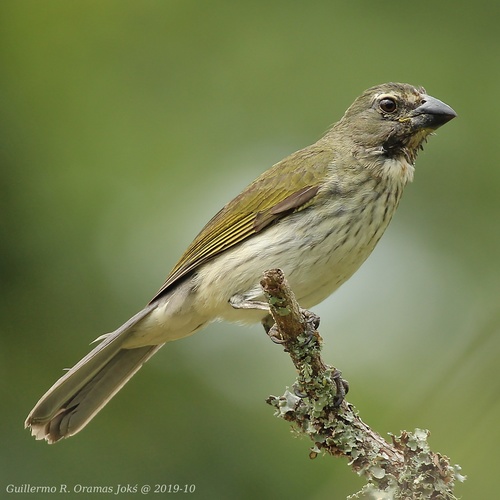
Streaked Saltator
Saltator striatipectus
A melodic resident of tropical gardens, the Streaked Saltator is easily recognized by its heavily patterned breast and thick, powerful bill. This adaptable songbird is a frequent visitor to backyard fruit feeders across Central and South America.
Quick Identification
Size
Length: 18.5-20 cm (7.3-7.9 inches); Weight: 33-40 g (1.1-1.4 oz)
Colors
Dull olive-green upperparts, pale cream or white underparts with heavy dusky-brown streaks, and a white eyebrow stripe.
Key Features
- Strongly streaked breast and belly
- Thick, dark finch-like bill often with a tiny pale tip
- Long white supercilium (eyebrow) above a dark eye line
- Dull olive-brown wings and back
When You’ll See Them
Sightings on EverydayEarth
Jul 1, 2026
A Red-crowned Woodpecker and a Streaked Saltator are visiting the feeding station together. The woodpecker is perched on the lower platform, actively pecking at banana slices, while the saltator perches on the mossy log above, observing the area before moving slightly closer to the fruit.
Geographic range
Where Does the Streaked Saltator Live?
The Streaked Saltator is native to the Neotropics, with a range that begins in Costa Rica and extends through Panama into South America. It is commonly found throughout the Andean foothills and lowlands of Colombia, Ecuador, Peru, and northern Venezuela, and also maintains a stable population on the island of Guadeloupe in the West Indies. This species is an expert at colonizing human-altered landscapes, making it a ubiquitous resident of tropical agricultural zones and residential neighborhoods.
Basemap © OpenStreetMap contributors
Behavior
The Streaked Saltator is a conspicuous and vocal bird often found in pairs or small family groups. Unlike many of its more skittish tanager cousins, it tends to be somewhat sluggish and approachable, frequently perching on exposed branches of shrubs or low trees to deliver its melodic, whistling song. It is a highly adaptable species that has learned to thrive alongside human development, making it a staple of suburban life in the tropics.
While they spend much of their time in the mid-canopy of trees, they aren't afraid to descend to lower levels or even visit the ground to forage for fallen fruit. They are socially active and will often join mixed-species foraging flocks, though they are usually the most 'relaxed' members of the group. In the garden, they are bold visitors to feeding stations, often asserting dominance over smaller birds when fruit is available.
EverydayEarth exclusive
Camera Tips
Streaked Saltators are fantastic subjects for backyard AI cameras because they are frequent visitors to feeding stations. To get the best shots, place your camera about 3 to 4 feet off the ground, facing a platform feeder. They prefer 'open-air' feeding rather than enclosed hopper styles. If you are using a trail camera in a more natural setting, look for the 'edge' where dense thicket meets a clearing, as these birds love to hop along these boundaries while foraging.
Baiting is the most effective way to ensure a sighting. Offer soft, overripe tropical fruits like bananas, papayas, or oranges. If you cut the fruit in half and nail it to a wooden post or branch in view of the camera, the saltator will spend several minutes perched and feeding, giving your AI camera plenty of time to capture high-quality images and video. They have a heavy bill and are very efficient at scooping out the pulp of soft fruits.
For the highest image quality, avoid placing the camera where it faces the direct morning or afternoon sun, as the Streaked Saltator’s olive and cream tones can easily become overexposed. A North-facing placement under the shade of a tree canopy works best. Because they are early risers, ensure your camera's sensitivity is high enough to capture motion in the dim light of dawn, which is often when they are most active and vocal.
Similar Species
Species that look similar or are commonly confused with Streaked Saltator.
Frequently Asked Questions
Record Streaked Saltator at your habitat
Connect a camera to start building your own species record — AI identifies every visitor automatically.