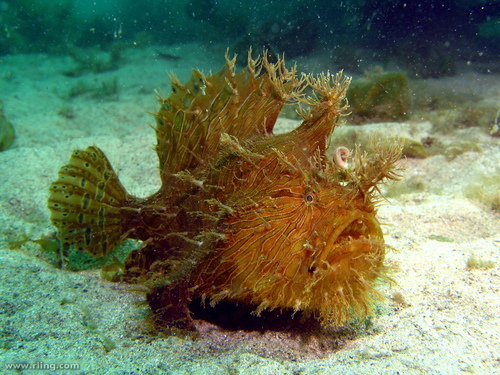
Striate Anglerfish
Antennarius striatus
The Striate Anglerfish is the ocean's ultimate shapeshifter, sporting a 'hairy' disguise and a built-in fishing rod. This master of camouflage doesn't just hide; it invites dinner to come to it.
Quick Identification
Size
Typically 10 to 15 cm (4 to 6 inches), with a maximum length reaching 22 cm (8.7 inches).
Colors
Extremely variable; can appear in shades of yellow, orange, green, brown, or solid black. Most specimens feature dark, radiating streaks or 'striations' and are covered in hair-like skin appendages.
Key Features
- Dense 'hairy' skin filaments (spinules)
- Modified dorsal fin lure (esca) that mimics a worm
- Pectoral fins modified into hand-like structures for walking
- Highly camouflaged body shape that breaks up its outline
When You’ll See Them
Geographic range
Where Does the Striate Anglerfish Live?
The Striate Anglerfish is a truly global marine citizen, primarily calling the tropical and subtropical waters of the Indo-Pacific home, from the Red Sea and East Africa across to the Hawaiian Islands and north to Japan. In the Atlantic Ocean, its range is equally impressive, stretching from the coast of New Jersey in the United States through the Caribbean and down to southern Brazil, while also appearing along the western shores of Africa. Because they prefer shallow, sheltered coastal environments, they are frequently encountered by shore divers and those exploring intercoastal waterways in tropical climates.
Basemap © OpenStreetMap contributors
Behavior
The Striate Anglerfish, often called the Hairy Frogfish, is a master of aggressive mimicry and patient ambush. Unlike most fish that spend their lives swimming, this species is largely sedentary, preferring to 'walk' across the seafloor using its modified pectoral and pelvic fins. These fins function much like limbs, allowing the fish to slowly stalk prey or settle into a perfect hiding spot among sponges or seagrass. Its most iconic behavior is its 'fishing' technique; it possesses a modified dorsal spine called an illicium, which it waves like a fishing rod. At the tip of this rod is a fleshy lure (the esca) that looks remarkably like a wriggling worm, used to entice curious smaller fish within striking range.
When a prey item moves close enough, the Striate Anglerfish exhibits one of the fastest feeding strikes in the animal kingdom. By rapidly expanding its oral cavity, it creates a powerful vacuum that sucks the prey into its mouth in as little as six milliseconds. Despite their lethargic appearance, they are highly successful predators. They are generally solitary creatures and are quite bold around divers or underwater cameras, relying on their incredible camouflage to remain 'invisible' rather than fleeing when approached.
EverydayEarth exclusive
Camera Tips
To capture the Striate Anglerfish on camera, you need to think like a bottom-dweller. If you live on a coastal property with a pier or dock, or have access to a shallow reef 'backyard,' use an underwater housing or a specialized waterproof trail camera. Position the camera at the substrate level—either on the sand or tucked near a sponge or pylon. These fish don't move much, so if you find one, it is likely to stay in the same square meter for several days. Aim the camera at a slight upward angle to capture the 'fishing' lure in action above the fish's head.
Lighting is your biggest challenge underwater. While the Striate Anglerfish is active during the day, they often hide in the shadows of piers. Use a diffuse video light rather than a harsh flash to avoid washing out the intricate textures of their 'hair.' If you are using an AI-triggered camera, set the sensitivity high; their movements are very slow and subtle, often limited to just the twitching of their lure. A time-lapse setting can be particularly effective for these stationary hunters, revealing how they slowly 'shuffle' across the sand over several hours.
Because they are masters of camouflage, look for things that don't quite belong—a 'hairy' rock or a sponge with eyes. Placing a small amount of fish remains or crushed shellfish nearby may attract the small fish and shrimp that the Anglerfish hunts, which in turn might trigger the Anglerfish to begin its 'fishing' display. Be sure to check your camera settings for a short focal distance, as these fish are small and you will want to get as close as 12–18 inches for a clear, detailed shot of their fascinating skin filaments.
Similar Species
Species that look similar or are commonly confused with Striate Anglerfish.
Frequently Asked Questions
Record Striate Anglerfish at your habitat
Connect a camera to start building your own species record — AI identifies every visitor automatically.