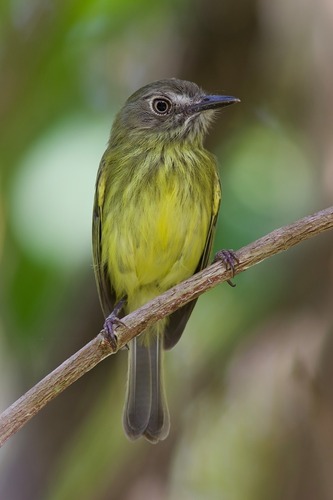
Stripe-necked Tody-Tyrant
Hemitriccus striaticollis
A master of the undergrowth, the Stripe-necked Tody-Tyrant is a tiny flycatcher with a big personality. Known for its distinctively streaked throat and piercing pale eyes, this elusive bird is a prize for any backyard observer in South America.
Quick Identification
Size
4.1–4.5 inches (10.5–11.5 cm); approximately 0.3 oz (8–10 g)
Colors
Olive-green upperparts with yellowish wing bars; whitish underparts featuring distinct dark grey or olive vertical streaks on the throat and neck; pale yellowish to white belly.
Key Features
- Prominent dark vertical streaks on the throat and neck
- Striking pale, creamy-white iris
- Small, flattened bill with a slight hook
- Dull olive-green back with two faint yellow wing bars
When You’ll See Them
Behavior
The Stripe-necked Tody-Tyrant is a discreet but active member of the flycatcher family. Unlike many of its more boisterous relatives, this tiny bird spends much of its time tucked away in the dense foliage of the understory. It is a classic 'sit-and-wait' predator, perching motionless on thin twigs while scanning the surrounding leaves for movement. When it spots a target, it performs a quick, acrobatic upward strike to snatch an insect from the underside of a leaf with an audible snap of its bill.
While not overly social with other species, they are frequently seen in pairs moving through the brush. Their movements are characterized by short, jerky flights. To the human observer, they are often heard before they are seen; their call is a rhythmic, mechanical clicking or trilling that blends into the ambient noise of the forest edge. They are not particularly fearful of humans but rely on their camouflaged plumage and the shadows of the thickets to remain unnoticed.
EverydayEarth exclusive
Camera Tips
To capture the Stripe-necked Tody-Tyrant on a trail camera, focus on the 'edge effect.' These birds love the transition zones where dense scrub meets a clearing or a garden path. Mount your camera at a height of about 3 to 5 feet (1 to 1.5 meters) off the ground, aiming it toward horizontal, slender perches. These birds prefer perching on thin branches that provide a clear view of the surrounding leaves rather than thick trunks.
Because these birds are small and move incredibly fast during a strike, use a high-speed trigger setting and, if possible, a burst mode of 3-5 photos. They are often triggered by motion in the mid-story, so ensure there isn't too much wind-blown vegetation directly in the foreground that might cause false triggers. Position the camera to face away from the rising or setting sun to prevent the bird's subtle neck streaks from being washed out by harsh backlighting; north-facing setups usually provide the most consistent light for detail.
While traditional feeders won't attract this species, you can lure them into your camera's frame by creating an insect-friendly micro-habitat. A small, shallow birdbath with a solar dripper is highly effective. The sound of dripping water is an irresistible magnet for tody-tyrants looking for a midday drink or a quick bath. Placing your camera near native flowering shrubs that naturally attract gnats and small flies will also significantly increase your chances of capturing their unique foraging behavior.
Similar Species
Species that look similar or are commonly confused with Stripe-necked Tody-Tyrant.
Frequently Asked Questions
Record Stripe-necked Tody-Tyrant at your habitat
Connect a camera to start building your own species record — AI identifies every visitor automatically.