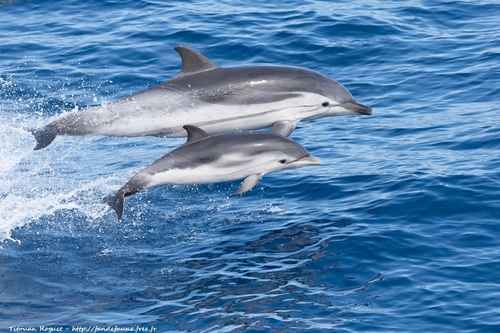
Striped Dolphin
Stenella coeruleoalba
Meet the ocean's most acrobatic athlete. Famous for their high-speed leaps and striking 'racing stripes,' the Striped Dolphin brings high-energy spectacle to deep blue waters.
Quick Identification
Size
Length of 1.8 to 2.5 meters (6 to 8.2 feet); weighs between 90 and 160 kg (200 to 350 lbs).
Colors
Distinctive blue-gray cape on the back, white or pinkish underside, and a signature dark stripe running from the eye to the pectoral fin and another down the flank.
Key Features
- Dark 'shroud' or cape on the dorsal side
- Unique stripe extending from the eye to the underside (anus area)
- Small, sickle-shaped dorsal fin located mid-back
- Frequently performs 'roto-tailing'—a high jump with a tail spin.
When You’ll See Them
Behavior
Striped Dolphins are among the most energetic and social cetaceans in the world. They are famous for their acrobatic displays, particularly a move known as 'roto-tailing,' where they leap high out of the water while rapidly rotating their tails. They usually travel in large pods ranging from 20 to several hundred individuals, though 'super-pods' of thousands have been recorded. Within these groups, they maintain complex social structures often segregated by age and breeding status.
While they are generally less likely to bow-ride than Bottlenose Dolphins, they are incredibly fast swimmers and can be observed surfacing in synchronized bursts. They are deep-water explorers, often foraging along the edges of continental shelves. Though they typically keep their distance from humans compared to other species, their sheer numbers and surface activity make them a spectacular sight for coastal observers.
EverydayEarth exclusive
Camera Tips
Since Striped Dolphins are pelagic, 'backyard' observation usually applies to coastal properties or those with boat access. To capture high-quality footage, position your AI-powered camera on a stable, elevated platform like a pier, a cliffside overlook, or a high-mounted pole on a vessel. Because they move at high speeds, set your camera to a high frame rate (at least 60fps) to avoid motion blur during their signature 20-foot leaps. Using a telephoto lens or a camera with optical zoom is essential, as these dolphins often stay several hundred yards offshore.
For those using automated trail cameras near the water, look for 'hotspots' where deep water comes close to shore—underwater canyons are prime locations. Polarization filters are a must-have for marine photography; they cut the glare from the ocean surface, allowing your AI to more accurately detect the dark shapes and distinctive stripes beneath the waves. If your camera supports it, enable 'burst mode' triggered by motion to ensure you capture the entire sequence of a roto-tailing jump rather than just the splash.
Lighting is your biggest challenge at sea. Early morning and late afternoon provide the 'golden hour' light that highlights the pink and white hues of their bellies against the deep blue water. Avoid pointing the camera directly into the sun to prevent silhouetting, which obscures the identifying stripes. If you are monitoring from a fixed coastal point, seasonal migrations are key—track local sightings to know when the largest pods are moving through your specific 'backyard' corridor.
Similar Species
Species that look similar or are commonly confused with Striped Dolphin.
Frequently Asked Questions
Record Striped Dolphin at your habitat
Connect a camera to start building your own species record — AI identifies every visitor automatically.