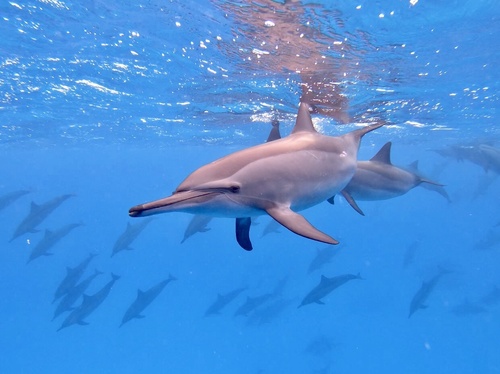
Spinner Dolphin
Stenella longirostris
The ocean’s most spectacular acrobat, the Spinner Dolphin, is a master of the air and sea. Watch as these slender, social mammals perform dizzying aerial rotations in the tropical sun.
Quick Identification
Size
Length: 4.3–7.9 ft (1.3–2.4 m); Weight: 100–170 lbs (45–80 kg)
Colors
Three-toned pattern: dark gray 'cape' on the back, light gray flanks, and a white or creamy underside.
Key Features
- Long, slender beak with a dark tip
- Triangular or slightly curved dorsal fin
- Small, slender body shape
- Capable of rotating up to 7 times in a single leap
- Dark stripe extending from the eye to the flipper
When You’ll See Them
Behavior
Spinner Dolphins are among the most charismatic and social cetaceans in the world. They are globally famous for their namesake behavior: leaping from the water and spinning rapidly along their longitudinal axis. While scientists still debate the exact reason for these acrobatics, they are believed to serve as social signals, a way to dislodge parasites like remoras, or simply a method of communication within the pod. These dolphins are highly social and are almost always found in groups, ranging from small family units to 'mega-pods' containing thousands of individuals.
Their daily routine follows a strict schedule dictated by the movement of their prey. They spend their daylight hours in shallow, sandy-bottomed bays or near coral reefs, where they rest and socialize while staying protected from deep-sea predators. As the sun sets, the pods move offshore into deeper water to begin their nightly hunt. Because they are mammals, they must remain conscious to breathe, so they engage in unihemispheric sleep—resting one half of their brain at a time while the other remains alert.
EverydayEarth exclusive
Camera Tips
Capturing Spinner Dolphins requires a departure from traditional terrestrial trail camera setups. If you live on a coastline or near a bay where these dolphins frequent, your best tool is a high-speed action camera or a waterproof housing for a DSLR. For an underwater setup, mount your camera on a weighted reef-safe tripod or a secure pier piling at a depth of 3 to 8 feet. Position the lens to face toward the 'blue water' or the mouth of the bay where dolphins enter. Because they move incredibly fast, set your camera to its highest possible frame rate (at least 60fps or 120fps for video) to capture their fluid motions.
If you are monitoring from the shore or a balcony, use an AI-powered camera with a high-zoom telephoto lens. The 'spinning' behavior usually occurs in the transition zones where the shallow bay meets deeper water. To get the best shots of their aerial displays, focus on the early morning hours when the light is golden and the dolphins are most active before their mid-day rest. A fast shutter speed of 1/2000 of a second is mandatory to freeze the water droplets and the dolphin's rotation without motion blur. Look for birds diving or 'boiling' water on the surface, as these are often indicators that a pod is nearby.
For those using smart detection software, prioritize 'motion' triggers over 'animal' triggers, as some AI models trained on terrestrial animals may not immediately recognize a dolphin fin. If your camera has a 'Pre-Roll' or 'Loop Recording' feature, enable it; this ensures that when the dolphin breaches, you capture the seconds leading up to the jump rather than just the splash. Avoid using artificial lights or flashes at night, as this can disorient the pod and interfere with their delicate echolocation and hunting patterns. Instead, rely on high-ISO settings and the natural moonlight for evening observations.
Similar Species
Species that look similar or are commonly confused with Spinner Dolphin.
Clymene Dolphin
Almost identical in color but has a shorter, thicker beak and a different 'mustache' mark on the top of the snout.
Common Bottlenose Dolphin
Much larger and chunkier with a shorter beak and lacks the distinct three-toned coloration of the Spinner.
Pantropical Spotted Dolphin
Easily distinguished by the white spots that cover the body of adults, though juveniles look very similar to Spinners.
Frequently Asked Questions
Record Spinner Dolphin at your habitat
Connect a camera to start building your own species record — AI identifies every visitor automatically.