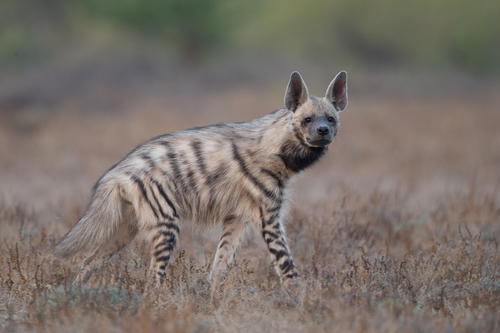
Striped Hyaena
Hyaena hyaena
The Striped Hyena is the silent ghost of the desert and scrubland, a solitary scavenger with a striking maned silhouette. Rarely seen by day, this elusive predator uses the cover of night to patrol vast territories with its keen sense of smell.
Quick Identification
Size
Body length of 100-115 cm (39-45 in) with a shoulder height of 60-80 cm (24-31 in). Weight ranges from 22-55 kg (49-121 lb).
Colors
Pale gray to straw-colored coat with distinctive vertical black stripes on the torso and horizontal stripes on the legs. Both sexes share the same coloration, though males may be slightly larger.
Key Features
- Sloping back profile with front legs significantly longer than hind legs
- Vertical black stripes across the body and legs
- Long, shaggy mane extending from the head to the base of the tail
- Large, pointed ears and a black patch on the throat
When You’ll See Them
Behavior
The Striped Hyena is a largely solitary and elusive creature, quite different from its more famous cousin, the Spotted Hyena. They typically travel alone or in pairs, rarely forming large clans. They are highly territorial and use scent marking to communicate with other hyenas in the area. Despite their reputation, they are shy around humans and will usually flee or hide rather than confront an intruder.
These animals are master scavengers, playing a vital role in their ecosystem by cleaning up carrion. However, they are also capable hunters and will take down small vertebrates or raid orchards for fruit. In many regions, they have adapted to living near human settlements, where they cautiously scavenge for organic waste under the cover of darkness.
EverydayEarth exclusive
Camera Tips
To capture a Striped Hyena on camera, placement is everything. These animals frequently use established game trails, dry riverbeds, and dirt roads to navigate their territory. Set your camera about 24 to 30 inches off the ground, angled slightly downward to capture their distinctive sloping profile. Because they are shy, avoid using cameras with a 'White Flash' as the bright light will likely spook them and prevent them from returning. Instead, opt for a 'No-Glow' or 'Black Flash' infrared camera that remains invisible to the animal's eyes.
If you are trying to attract one to a specific spot, scent is your best tool. Striped Hyenas have an incredible sense of smell. A pungent bait like aged meat or even a rag soaked in fish oil can draw them in. However, they are also attracted to sweet scents; in some regions, researchers use melon or fruit-based lures. Place the lure about 10-15 feet in front of the camera to ensure the animal stays in the frame long enough for a clear shot. Since they are scavengers, they will often spend several minutes investigating a scent, giving you ample time for high-quality video.
Be patient and check your settings. Set your camera for a 15-30 second video trigger with a short reset interval. Striped Hyenas move with a characteristic lumbering gait, and a single still photo might only catch a blurry tail or a pair of eyes. High-definition video allows you to see the mane raise or lower—a key behavior when they feel threatened or curious. During the summer months, focus your efforts near water sources or shaded rocky outcrops where they might den during the heat of the day.
Similar Species
Species that look similar or are commonly confused with Striped Hyaena.
Frequently Asked Questions
Record Striped Hyaena at your habitat
Connect a camera to start building your own species record — AI identifies every visitor automatically.