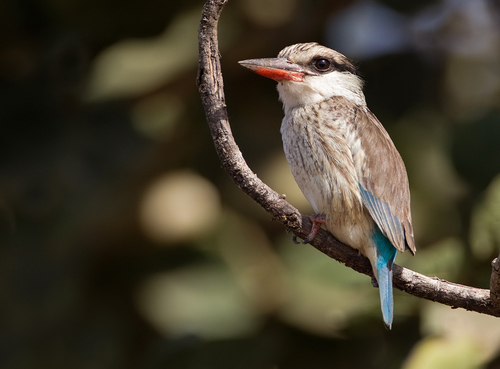
Striped Kingfisher
Halcyon chelicuti
A charismatic dry-land hunter, the Striped Kingfisher is the vocal soul of the African savanna. Known for its streaked crown and vibrant wing-flashing displays, it’s a master of the 'sit-and-wait' hunt.
Quick Identification
Size
16–18 cm (6.3–7.1 in) in length; wingspan approx. 25–30 cm (10–12 in); weighs 30–50 g (1.1–1.8 oz)
Colors
Greyish-brown streaked crown, white collar, black eye-streak, dull blue rump and tail feathers, off-white underparts with fine dark streaks, bicoloured bill (black upper, red lower)
Key Features
- Distinctive heavily streaked crown and nape
- Black mask-like stripe through the eye
- Dull blue wing and tail patches visible in flight
- Small, stocky profile with a large, heavy bill
When You’ll See Them
Geographic range
Where Does the Striped Kingfisher Live?
The Striped Kingfisher is a widespread resident across the vast landscapes of sub-Saharan Africa. Its native range extends from the semi-arid belts of Senegal and Ethiopia down through the East African savannas to the northern regions of South Africa and Namibia. It is conspicuously absent from the dense, humid rainforests of the Congo Basin and the most extreme desert regions, preferring the transition zones where trees meet open ground.
Basemap © OpenStreetMap contributors
Behavior
The Striped Kingfisher is a highly vocal and territorial bird that, unlike many of its relatives, lives far from water. It is most famous for its loud, piercing 'cheer-oh' duet, often performed by pairs to mark their territory. During this display, the birds perch upright, spread their wings to reveal hidden blue feathers, and bob their heads in a synchronized rhythm.
These kingfishers are 'sit-and-wait' hunters. They spend much of their day perched motionless on low branches, fence posts, or telephone wires, scanning the ground for movement. They are solitary or found in pairs, and while they are generally wary of humans, they have adapted well to modified landscapes like farms and large suburban gardens where tall trees provide nesting sites and perches.
EverydayEarth exclusive
Camera Tips
To capture high-quality footage of a Striped Kingfisher, you should look for 'sentinel perches' rather than water features. These birds love consistent, high-vantage points such as the tips of dead branches, fence posts, or the corners of garden sheds. Mount your AI camera at a height of 5 to 8 feet, angled slightly downward to cover both the perch and the patch of ground immediately below it where they are likely to strike for prey.
Because the Striped Kingfisher relies on motion to find its food, maintaining a patch of 'natural' or slightly longer grass near your camera setup can attract the grasshoppers and beetles that make up their primary diet. Avoid using broad-spectrum insecticides in your yard, as a healthy insect population is the best natural 'bait' for this species. If you have a birdbath, place a sturdy, horizontal branch nearby; they rarely swim but will often use a branch to stage a quick dive into the water for a bath.
Lighting is crucial for this species because their blue feathers are structural rather than pigmented. To see that iconic flash of blue on their rump and wings, position your camera so it is back-lit or side-lit during the golden hours of the morning (7-9 AM) or late afternoon (4-6 PM). Use a high-sensitivity motion trigger setting, as their pounce from a branch to the ground is lightning-fast and can be missed by slower sensors.
Similar Species
Species that look similar or are commonly confused with Striped Kingfisher.
Frequently Asked Questions
Record Striped Kingfisher at your habitat
Connect a camera to start building your own species record — AI identifies every visitor automatically.