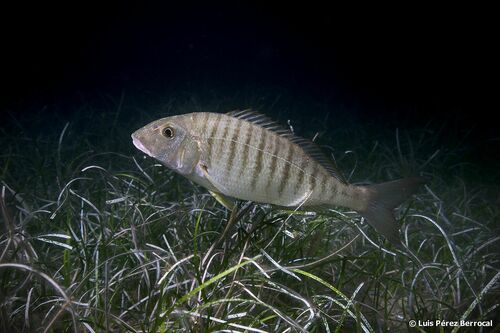
Striped Seabream
Lithognathus mormyrus
A shimmering visitor of the sandy shallows, the Striped Seabream is famous for its bold personality and striking pinstriped appearance. Whether they are sifting the sand for treats or curiously nipping at a swimmer's toes, these social fish are a highlight of coastal underwater discovery.
Quick Identification
Size
Typically ranges from 25–30 cm (10–12 in) in length, though exceptional individuals can reach 55 cm (22 in) and weigh up to 1.2 kg (2.6 lbs).
Colors
Brilliant silver-white body with 14 to 15 narrow, dark vertical stripes extending across the upper two-thirds of the flanks. The snout is often darker, while fins are translucent or pale gray.
Key Features
- 14-15 dark vertical stripes on silver body
- Elongated, pointed snout with thick lips
- Highly compressed, oval-shaped profile
- Deeply forked tail fin
When You’ll See Them
Geographic range
Where Does the Striped Seabream Live?
Native to the temperate and subtropical waters of the Eastern Atlantic, the Striped Seabream can be found from the Bay of Biscay in France southward to the Cape of Good Hope in South Africa. This resilient fish is a common sight throughout the entire Mediterranean Sea and extends its presence into the Red Sea and along the western Indian Ocean coast near Mozambique. It thrives in the surf zone of sandy beaches and around the edges of Posidonia seagrass beds.
Basemap © OpenStreetMap contributors
Behavior
The Striped Seabream is a highly social and gregarious species, often found patrolling the seabed in large, shimmering schools. They are dedicated bottom-feeders, spending their daylight hours hovering just above the sand. Using their specialized, elongated snouts, they dive into the substrate to 'root' for food, a behavior that frequently kicks up clouds of sand and debris. This activity often attracts smaller opportunistic fish that follow the seabream to pick up any scraps left behind.
In many coastal regions, this fish has earned the humorous nickname 'common bastardfish' among beachgoers. This is due to their bold behavior in shallow water; they are known to approach stationary swimmers and nip at their legs or feet. While this can be a startling sensation for a human, it is not an act of aggression—the fish are simply investigating whether the swimmer's skin or the sand they have disturbed contains any edible organisms.
EverydayEarth exclusive
Camera Tips
To capture high-quality footage of the Striped Seabream, you will need a waterproof action camera or a dedicated underwater trail camera. Because these fish prefer the surf zone, the best placement is on a weighted tripod or a heavy flat plate positioned on the sandy bottom in 1 to 3 meters of water. Aim the camera at a slight downward angle toward the sand to catch their unique 'rooting' behavior as they search for worms. Ensure the camera is placed where the sand meets a seagrass bed, as this is a natural corridor for schooling bream.
Clarity is your biggest challenge when filming in the surf. Choose days with low swell and offshore winds to ensure the water isn't filled with suspended silt. To attract a school to your camera's field of view, you can use a small 'chum' dispenser filled with crushed mussels or bread. Even just disturbing the sand manually with a rake before setting the camera can create a plume of scent and debris that will draw the fish in within minutes. Use a high frame rate (at least 60fps) to capture their quick, darting movements and the metallic shimmer of their scales.
Lighting is crucial for underwater photography. The silver scales of the Striped Seabream can easily 'blow out' and lose detail in bright, overhead sun. Try to position your camera with the sun at your back so the light hits the side of the fish, highlighting the dark vertical stripes. Avoid filming in very deep water without an external light source, as the characteristic silver and gray tones will appear dull and blue. If you are setting a camera in an estuary or lagoon, be mindful of the tides; secure your equipment firmly so it doesn't get swept away by changing currents.
Similar Species
Species that look similar or are commonly confused with Striped Seabream.
Frequently Asked Questions
Record Striped Seabream at your habitat
Connect a camera to start building your own species record — AI identifies every visitor automatically.