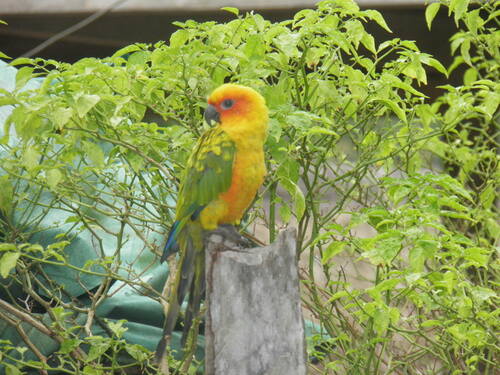
Sulphur-breasted Parakeet
Aratinga maculata
A dazzling splash of yellow and green in the Amazonian sky, the Sulphur-breasted Parakeet is a social marvel. Once thought to be a hybrid, this unique species is now celebrated as a distinct gem of the Brazilian savanna.
Quick Identification
Size
Length of approximately 30 cm (12 inches); weight ranges from 110 to 130 grams (3.9 to 4.6 oz).
Colors
Vibrant sulphur-yellow plumage on the head, neck, and breast, often with a soft orange wash on the face; distinct green wing coverts and dark blue flight feathers.
Key Features
- Bright sulphur-yellow head and mantle
- Extensive green feathering on the wings
- Long, pointed tail with blue-green tips
- Bare white skin ring around the eye
When You’ll See Them
Geographic range
Where Does the Sulphur-breasted Parakeet Live?
This vibrant parakeet is native to the South American continent, specifically localized within the lower Amazon basin. Its core range is centered in the Brazilian state of Pará, though populations are also found in the neighboring regions of Suriname and French Guiana. Unlike many widespread parrots, it occupies a relatively compact geographic footprint focused on the transition zones between dense rainforest and open savanna.
Basemap © OpenStreetMap contributors
Behavior
Sulphur-breasted Parakeets are highly social and gregarious birds, almost always found in small flocks or larger communal groups. They are famously vocal, emitting loud, shrill screeches while in flight or when settling into a feeding tree. These calls serve as vital communication to keep the flock together as they move through the dense canopy or across open savannas.
In the wild, they exhibit complex social behaviors including mutual preening, which helps reinforce pair bonds and social hierarchies. While they spend much of their day foraging for food, they are also known for their playful nature, often seen hanging upside down or performing acrobatic maneuvers among the branches. Although naturally wary of humans, they can become habituated to areas near rural settlements where fruiting trees are abundant.
EverydayEarth exclusive
Camera Tips
To capture the stunning yellow of the Sulphur-breasted Parakeet, place your AI-powered camera near known food sources like fruiting Cecropia trees or palms. These birds are canopy-dwellers, so if you are placing a camera in an orchard or a backyard near their range, aim for an elevated position. Mount your camera at least 6 to 10 feet off the ground, angled slightly upward or positioned to view a reliable perching branch where the flock gathers before dropping down to feed.
Parakeets are highly attracted to water, especially during the hotter parts of the day. A high-elevation bird bath or a dripping water feature can be a magnet for a thirsty flock. When setting up near water, ensure your camera has a fast trigger speed; these birds are twitchy and move with sudden, erratic bursts. Use 'burst mode' or short video clips to capture their social interactions, as they often preen or squabble while bathing, providing excellent behavioral footage.
In terms of camera settings, these birds are exceptionally bright. Direct midday sun can 'blow out' the yellows on their chest, making them look like glowing white silhouettes on camera. If possible, position the camera so the sun is behind it, or in a spot that receives filtered morning light. High-resolution video (1080p or 4K) is highly recommended to distinguish them from the very similar Sun Parakeet, as the specific green feather patterns on the wings are the primary identifying mark.
Since these parakeets are social, one bird usually acts as a lookout while the others feed. If your camera triggers on a single bird, keep it recording—the rest of the flock is likely just seconds away. Using a solar panel attachment for your camera is a wise investment, as the high activity of a large flock can trigger the sensor dozens of times in a single hour, draining standard batteries quickly during their morning and afternoon feeding frenzies.
Similar Species
Species that look similar or are commonly confused with Sulphur-breasted Parakeet.
Frequently Asked Questions
Record Sulphur-breasted Parakeet at your habitat
Connect a camera to start building your own species record — AI identifies every visitor automatically.