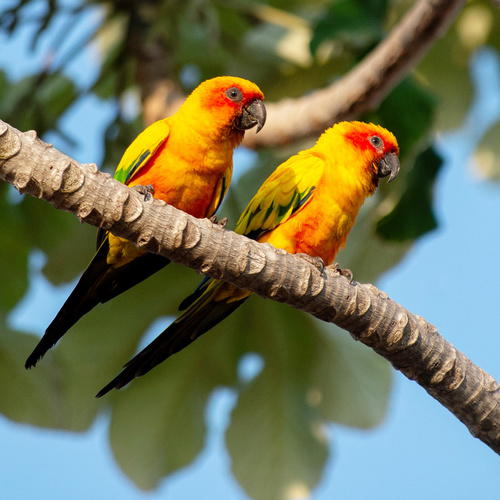
Sun Parakeet
Aratinga solstitialis
Meet the Sun Parakeet, a living jewel of the South American savanna. Known for its radiant golden plumage and high-spirited personality, this endangered parrot is a master of social living and tropical survival.
Quick Identification
Size
Total length of 30 cm (12 inches); weight ranges from 100-120 g (3.5-4.2 oz)
Colors
Brilliant golden-yellow body with vibrant orange-red flushing on the face and belly; wings show green coverts and deep blue flight feathers
Key Features
- Radiant golden-yellow plumage across the head and mantle
- Vivid orange patches on the face and abdomen
- Long, tapered tail with olive-green and blue tips
- Powerful, black hooked beak and white bare eye-rings
When You’ll See Them
Geographic range
Where Does the Sun Parakeet Live?
The Sun Parakeet is native to the northeastern corner of South America, concentrated primarily within the Guiana Shield. This stunning bird's core range encompasses Guyana, Suriname, southern French Guiana, and the northern Brazilian state of Roraima. While once more widespread, they are now localized to these specific tropical regions where savanna meets primary forest.
Basemap © OpenStreetMap contributors
Behavior
Sun Parakeets are exceptionally social and expressive birds, almost always found in tight-knit flocks ranging from a few individuals to thirty or more. Their presence is usually announced long before they are seen, thanks to their piercing, high-pitched vocalizations which they use to maintain contact while flying through dense canopy or foraging. Within these flocks, they form strong monogamous bonds, and pairs are often observed preening one another to reinforce their social connection.
In the wild, they are highly active during the day, spending their time moving between roosting sites and foraging grounds. They are remarkably agile flyers, capable of rapid, direct flight. While they spend much of their time in the treetops, they are curious by nature and will occasionally descend to lower levels to investigate food sources or water. Their intelligence and social complexity make them a favorite in aviculture, though in their native habitat, they remain cautious of terrestrial predators.
EverydayEarth exclusive
Camera Tips
To capture the Sun Parakeet on a backyard or trail camera, focus your efforts on water sources and fruiting trees. Because they are canopy-dwellers, placing your camera at a slight upward angle towards a birdbath or a platform feeder stocked with tropical fruits like papaya or mango can yield excellent results. If you are in their native range, look for stands of Mauritia palms, as these are a magnet for the species. Set your camera at a height of 5 to 8 feet if possible, or use a mounting bracket to secure it to a high branch overlooking a clearing.
Given their vibrant yellow and orange colors, Sun Parakeets can sometimes 'blow out' or overexpose in direct, midday tropical sun. Position your camera to face North or South to avoid the harshest direct sunlight, or place it under a slight canopy cover to utilize dappled light, which brings out the richness of their plumage. High-speed shutter settings are essential, as these birds are fast movers and frequently flutter their wings even while perched.
For the best activity, ensure your camera is active during the 'golden hours' shortly after sunrise and before sunset. They are most vocal and active during these times as they move from roosting to feeding sites. Since they travel in flocks, set your camera to 'Burst Mode' or 'Photo + Video' mode; this allows you to capture the initial bird landing and the subsequent social interactions as the rest of the flock follows.
Similar Species
Species that look similar or are commonly confused with Sun Parakeet.
Frequently Asked Questions
Record Sun Parakeet at your habitat
Connect a camera to start building your own species record — AI identifies every visitor automatically.