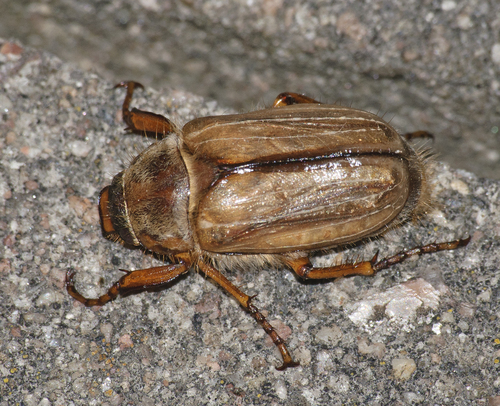
Summer Chafer
Amphimallon solstitiale
Often called the 'June Bug' of Europe, the Summer Chafer is a bumbling, golden-brown beetle famous for its sunset swarms. Watch for them buzzing around tree tops and porch lights during the warm evenings of the summer solstice.
Quick Identification
Size
15-20 mm (0.6-0.8 inches) in length
Colors
Sandy yellow to light brownish-orange wing cases; thorax is noticeably fuzzier with pale, cream-colored hairs.
Key Features
- Fine, dense hairs covering the thorax and legs
- Three raised longitudinal ridges on each wing case (elytra)
- Fan-like, clubbed antennae (lamellate)
- Rounded, oval body shape typical of the scarab family
When You’ll See Them
Behavior
The Summer Chafer is a quintessential sound of the midsummer garden, known for its loud, buzzing flight that begins almost precisely at sunset. Unlike many beetles that stay hidden, these insects are famous for their 'dusk dance,' where they swarm in large numbers around the tops of trees, chimneys, or garden structures to find mates. They are notoriously clumsy flyers, frequently bumping into windows, walls, and even people, which can be startling but is entirely harmless as they do not bite or sting.
During the day, they remain tucked away in long grass or foliage, emerging only when the light fades. They are highly phototactic, meaning they are drawn to artificial light sources. This behavior often leads them into homes through open windows or causes them to exhaust themselves circling outdoor lamps. While the adults live for only a few weeks to breed and feed on leaves, their larvae spend years underground, playing a significant role in the soil ecosystem before emerging for their brief summer debut.
EverydayEarth exclusive
Camera Tips
Capturing the Summer Chafer on a backyard camera requires a strategy built around light and elevation. Since these beetles are most active during the 'blue hour' at dusk, your camera’s infrared sensors might not always trigger on such small, fast-moving targets. To solve this, place your camera near a soft artificial light source, like a solar garden lantern or a porch light. The beetles will be drawn to the glow, slowing down their flight and giving your AI-powered camera a much better chance to lock focus and identify them.
For the best perspective, mount your camera at head-height or higher, angled toward the silhouette of a tree canopy or a tall hedge. This is where the Summer Chafer 'swarms' occur. Using a tripod or a fence mount is better than a low ground placement, as these beetles spend very little time on the ground once they emerge for the evening. If your camera has a 'high sensitivity' motion setting, enable it; their buzzing flight is rapid, and standard settings might miss the split-second window when they pass the lens.
If you are looking for high-quality video, try to position the camera so it has a clear view of the sky just after sunset. The backlighting from the fading sun will highlight the fine hairs on their thorax and the translucent quality of their wings. Because they are often active on warm, humid nights, ensure your camera lens is treated with an anti-fog coating to prevent evening dew from blurring your shots. Finally, check your camera the morning after a warm June night; you may find them resting on the mounting straps or nearby foliage, offering a perfect opportunity for a still macro shot while they are dormant in the daylight.
Similar Species
Species that look similar or are commonly confused with Summer Chafer.
Frequently Asked Questions
Record Summer Chafer at your habitat
Connect a camera to start building your own species record — AI identifies every visitor automatically.