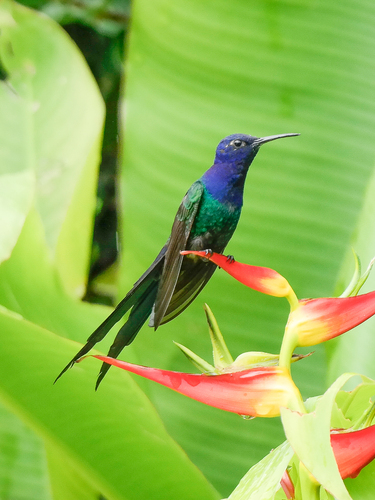
Swallow-tailed Hummingbird
Eupetomena macroura
With its dramatic forked tail and shimmering violet hood, the Swallow-tailed Hummingbird is a master of the air. This bold, territorial beauty is a favorite for backyard observers across South America.
Quick Identification
Size
Length: 15–19 cm (6–7.5 in); Wingspan: approx. 20 cm (8 in); Weight: 8–9 g (0.28–0.32 oz)
Colors
Brilliant iridescent violet-blue head, neck, and upper chest; shimmering deep green body; dark, metallic blue-black tail.
Key Features
- Long, deeply forked 'swallow' tail
- Vibrant violet-blue hood contrasting with a green body
- Large size and robust build for a hummingbird
- Thick, slightly decurved black bill
When You’ll See Them
Behavior
The Swallow-tailed Hummingbird is renowned for its bold and remarkably territorial nature. Often described as the 'king' of the garden, it is not uncommon to see this species aggressively chasing away other birds—sometimes even those significantly larger than itself, like hawks or flycatchers. They are highly vocal aerialists, frequently emitting sharp 'tsip' calls while perched or patrolling their territory.
Unlike many shy forest-dwelling hummingbirds, this species has adapted brilliantly to human presence. They are highly inquisitive and will often hover just a few feet away from people to investigate a brightly colored shirt or a new feeder. In social hierarchies at feeding stations, they almost always occupy the top spot, forcing other hummingbirds to wait their turn.
EverydayEarth exclusive
Camera Tips
To capture the stunning iridescent plumage of the Swallow-tailed Hummingbird, camera placement is everything. Position your AI-powered camera within 2 to 4 feet of a high-traffic nectar source, such as a red or orange hummingbird feeder or a cluster of tubular flowers like Salvia or Russelia. Because these birds are territorial, look for a nearby 'sentinel perch'—usually a bare twig or wire with a clear view of the food source—and aim a second camera there to catch them in a rare moment of stillness.
Lighting is the 'secret sauce' for this species. To avoid the bird appearing as a dark silhouette, ensure the sun is behind the camera lens. This direct light hits the microscopic structure of their feathers, causing the brilliant violet-blue and emerald-green colors to 'pop' on digital sensors. If your camera allows for manual adjustments, a high shutter speed (1/1000s or faster) is ideal to freeze the motion of their wings, which can beat up to 70 times per second.
Since Swallow-tailed Hummingbirds are most active during the 'Golden Hours' of dawn and dusk, check that your camera’s low-light settings are optimized. Using a 'Burst Mode' or high-frequency trigger setting is highly recommended, as their movements are incredibly fast. Capturing the moment they spread their deeply forked tail during a territorial display or a sudden landing provides the most iconic and rewarding shots for any backyard wildlife enthusiast.
Similar Species
Species that look similar or are commonly confused with Swallow-tailed Hummingbird.
Frequently Asked Questions
Record Swallow-tailed Hummingbird at your habitat
Connect a camera to start building your own species record — AI identifies every visitor automatically.