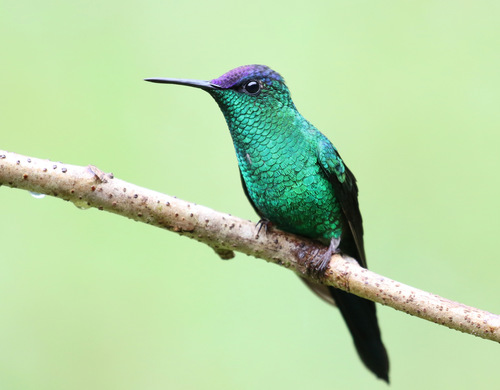
Violet-capped Woodnymph
Thalurania glaucopis
A shimmering jewel of the South American forest, the Violet-capped Woodnymph dazzles with its namesake purple crown and emerald green breast. This bold hummingbird is a favorite for backyard observers, frequently visiting feeders and garden flowers with acrobatic grace.
Quick Identification
Size
8–11 cm (3.1–4.3 in) in length; Weight approx 4–6 grams (0.14–0.21 oz)
Colors
Males have a brilliant violet-blue crown, shimmering emerald green throat and breast, and a dark blue forked tail. Females are metallic green above with pale grayish-white underparts and white-tipped outer tail feathers.
Key Features
- Iridescent violet-blue crown on males
- Deeply forked, dark steel-blue tail
- Brilliant emerald green gorget (throat)
- Slightly decurved black bill
- Females feature clean grayish-white underparts
When You’ll See Them
Behavior
The Violet-capped Woodnymph is a spirited and territorial resident of the Atlantic Forest regions. Known for their high energy, these hummingbirds are frequently seen patrolling a "trap-line" of nectar sources, vigorously defending their favorite flowers or garden feeders from competitors. They are remarkably agile, capable of hovering for extended periods and performing sudden, darting maneuvers to snatch tiny insects from the air.
In backyard settings, they are relatively bold and can become quite accustomed to human activity, especially if a consistent food source is provided. Males are particularly conspicuous, often perching on open twigs between feeding bouts to survey their territory and display their iridescent plumage to potential mates or rivals. Their flight is accompanied by a low-pitched humming sound, characteristic of their rapid wingbeats.
EverydayEarth exclusive
Camera Tips
To capture the stunning iridescence of the Violet-capped Woodnymph, camera placement is critical. Position your AI-powered camera about 3 to 5 feet away from a nectar feeder or a cluster of high-reward flowers like Shrimp Plants or Salvias. Ensure the lens is at the same height as the feeding ports—typically 4 to 5 feet off the ground—to get an intimate, eye-level perspective of the bird. Avoid pointing the camera directly into the sun; instead, place it so the morning or evening light hits the bird from the side or front, which will make the violet crown and green throat truly 'glow' on film.
Because these birds are incredibly fast, your camera's shutter speed or trigger sensitivity is paramount. If using a customizable trail camera, set it to the fastest possible trigger speed and use a multi-shot burst mode. This increases your chances of catching the bird in a perfect hovering pose rather than just a blur of wings. For the best AI identification results, ensure the background is relatively simple—a distant wall of green leaves works better than a cluttered fence, as it helps the camera's focus lock onto the small, fast-moving subject.
In South American backyards, these birds are year-round residents, but you can increase 'traffic' during the dry season by keeping your nectar feeders clean and filled. Using a 4:1 water-to-sugar ratio is standard. If your camera has a macro setting, use it; hummingbirds are so small that they can easily get lost in a wide-angle frame. Try to frame the shot so the feeder occupies one side of the image, leaving open space for the woodnymph to enter the frame and hover, which provides the AI with a clear view of the male's distinct violet cap.
Similar Species
Species that look similar or are commonly confused with Violet-capped Woodnymph.
Fork-tailed Woodnymph
The Fork-tailed Woodnymph male has violet on the back and belly, whereas the Violet-capped is primarily green on the body with the violet restricted to the crown.
Swallow-tailed Hummingbird
Much larger with a significantly longer, deeply forked tail and a completely blue head and breast rather than just a cap.
Frequently Asked Questions
Record Violet-capped Woodnymph at your habitat
Connect a camera to start building your own species record — AI identifies every visitor automatically.