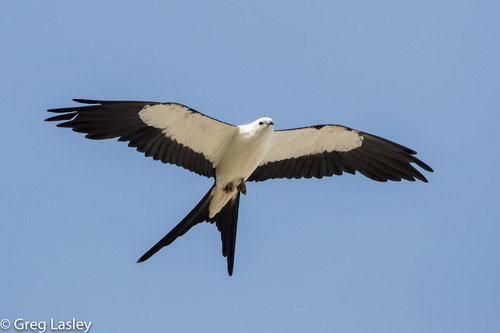
Swallow-tailed Kite
Elanoides forficatus
Witness the most elegant acrobat of the sky. With its unmistakable forked tail and effortless gliding, the Swallow-tailed Kite turns every flight into a masterclass of aerial agility.
Quick Identification
Size
Length: 19-26 in (48-66 cm); Wingspan: 45-54 in (114-137 cm); Weight: 13-21 oz (370-600 g)
Colors
High-contrast palette featuring a pure white head, neck, and underparts against deep black-to-iridescent-blue wings and tail. Males and females are identical in plumage.
Key Features
- Deeply forked 'V' shaped black tail
- Striking contrast of pure white body and black wings
- Long, pointed wings with a 4-foot span
- Smooth, acrobatic flight with frequent tail rotations
- Slim, elegant silhouette in flight
When You’ll See Them
Behavior
The Swallow-tailed Kite is widely considered one of the most graceful fliers in the avian world. Unlike many raptors that perch to search for prey, these kites spend the vast majority of their day on the wing, drinking, bathing, and even eating while in flight. They use their deeply forked tails as a rudder, twisting it nearly 90 degrees to make sharp, effortless turns through the canopy or over open fields. They are highly social birds, often seen foraging in small groups or nesting in loose colonies within the tops of the tallest available trees.
While they are masters of the air, they are relatively shy around human activity on the ground. However, they have adapted well to suburban fringes that border wetlands or pine flatwoods. They are not aggressive toward humans, but they are vocal near their nesting sites, emitting thin, high-pitched whistling calls to communicate with mates or warn off intruders. Their social nature is most evident during the late summer when hundreds may congregate in 'pre-migratory roosts' before their long journey back to South America.
EverydayEarth exclusive
Camera Tips
Capturing a Swallow-tailed Kite on a backyard camera requires a departure from traditional ground-level setups. Because these birds rarely touch the ground except to occasionally gather nesting material, your camera should be positioned with a clear, wide-angle view of the sky or the very tops of the tree canopy. If you have a tall pole or can safely mount a camera to a second-story eave, aim it upward at a 45-degree angle toward an open flight path. They are creatures of habit, often following the same aerial corridors each day as they move between roosting and hunting grounds.
To increase your chances of a close-up, focus on 'fly-by' zones rather than 'landing' zones. Kites are drawn to areas with high dragonfly activity, so placing a camera near a backyard pond or a sun-drenched meadow can yield excellent results. They are particularly active during the hottest part of the day when thermal updrafts allow them to glide effortlessly. Set your camera’s trigger speed to the fastest possible setting; these birds move with deceptive speed, and a slow sensor will result in nothing but a white blur.
During the spring nesting season (March through May), Swallow-tailed Kites look for Spanish moss and small twigs to build their nests. If you live in the Southeastern US, placing a camera with a view of a tall, moss-draped pine or cypress tree might reward you with footage of their incredible 'snatch-and-grab' technique. They don't land to gather moss; they swoop in and pull it away in one fluid motion. Use a high frame rate for video to capture the intricate tail movements they use to stabilize themselves during these maneuvers.
Finally, consider the lighting. Because of their stark white undersides, they can easily 'blow out' or become overexposed in bright midday sun. If your AI camera allows for exposure adjustment, try underexposing by a fraction to preserve the detail in their white feathers. Early morning or late afternoon light provides a warmer glow and helps highlight the iridescent sheen on their black wing feathers, making for a much more dramatic and professional-looking capture.
Similar Species
Species that look similar or are commonly confused with Swallow-tailed Kite.
Mississippi Kite
Smaller and predominantly gray with a blunt, squared tail rather than a deep fork.
Magnificent Frigatebird
Also has a forked tail, but is much larger, all black (males), and found strictly along coastal shorelines.
Scissor-tailed Flycatcher
Much smaller songbird with a similar tail, but features salmon-pink flanks and a very different flight pattern.
Frequently Asked Questions
Record Swallow-tailed Kite at your habitat
Connect a camera to start building your own species record — AI identifies every visitor automatically.