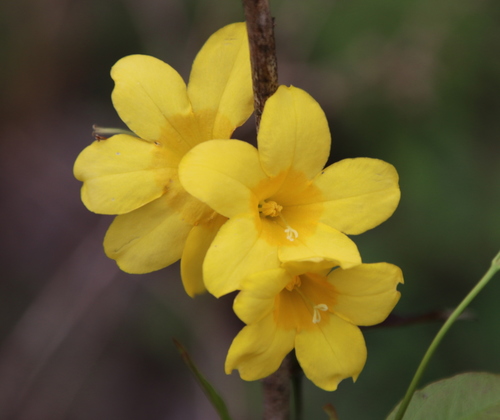
Swamp Jessamine
Gelsemium rankinii
A double-blooming beauty of the Southern wetlands, the Swamp Jessamine lights up the garden with brilliant yellow trumpets in both spring and fall.
Quick Identification
Size
Twining vine reaching 10-20 feet (3-6 meters) in length; leaves 2-4 inches (5-10 cm) long
Colors
Brilliant lemon-yellow flowers; dark, glossy evergreen leaves; reddish-brown woody stems
Key Features
- Funnel-shaped yellow flowers with five lobes
- Glossy, dark green opposite leaves
- Twining woody vine habit
- Lack of fragrance compared to other Jessamines
When You’ll See Them
Behavior
Swamp Jessamine is a perennial evergreen vine known for its remarkable climbing ability. Using its slender, woody stems, it twines around trees, shrubs, and fences to reach the sunlight. Unlike many other flowering vines that have a single short-lived season, this species is famous for its 'bimodal' blooming habit, producing a heavy flush of flowers in the early spring and a second surprising show in the autumn.
While it is a beautiful addition to a landscape, it is a vigorous grower that provides essential structural cover for backyard birds throughout the winter. It is important to note that all parts of the plant are highly toxic if ingested by humans or livestock, and the sap can occasionally cause skin irritation in sensitive individuals. In the wild, it serves as a critical nectar source for early-emerging pollinators when few other plants are in bloom.
EverydayEarth exclusive
Camera Tips
To capture the stunning display of Swamp Jessamine, set your camera to a time-lapse mode rather than relying solely on motion triggers. Because the vine itself is stationary, a time-lapse interval of 15–30 minutes during daylight hours will allow you to document the 'unfolding' of the trumpet-shaped blooms over several days. If you are specifically looking to catch visitors, use a high-sensitivity motion trigger and position the lens about 2 to 3 feet away from a dense cluster of flowers. These blooms are magnets for native bees and spicebush swallowtail butterflies.
Lighting is the most critical factor when photographing this species with a trail camera. Because the flowers are a vibrant, reflective lemon-yellow, they can easily 'blow out' in direct midday sun, causing the image to lose detail. Position your camera to face North or South to get soft side-lighting, or focus your capture window for the 'golden hours' of early morning or late afternoon. This enhances the contrast between the yellow petals and the deep green, glossy foliage.
In a backyard setting, encourage the vine to grow along a fence or a trellis at eye level (4-5 feet). This allows for a stable camera mount—using a tree clamp or a sturdy tripod—without the foreground foliage blocking the view. If you are placing a camera in the wild, look for the vine clambering over lower shrubs near water sources. Ensure your camera is well-secured, as the soft, peaty soil of the Swamp Jessamine's natural habitat can cause mounts to shift or sink over time, which will ruin the framing of a long-term time-lapse project.
Similar Species
Species that look similar or are commonly confused with Swamp Jessamine.
Frequently Asked Questions
Record Swamp Jessamine at your habitat
Connect a camera to start building your own species record — AI identifies every visitor automatically.