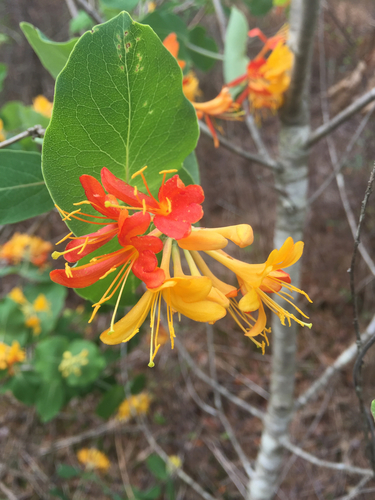
Yellow Honeysuckle
Lonicera flava
The Yellow Honeysuckle is a radiant native climber that turns any backyard into a bustling hub for hummingbirds and butterflies. Its unique fused leaves and golden trumpet-shaped blooms make it a standout star of the spring landscape.
Quick Identification
Size
A woody vine reaching lengths of 10-20 feet (3-6 meters)
Colors
Bright yellow to orange-yellow flowers; dull green to bluish-green leaves with a waxy, pale underside
Key Features
- Terminal clusters of 2-3 inch tubular yellow flowers
- Upper leaves are fused together (connate-perfoliate) to form a single disk-like leaf
- Non-twining, trailing or climbing woody stems
- Smooth, glaucous (waxy) foliage and stems
When You’ll See Them
Behavior
Yellow Honeysuckle is a relatively well-behaved, deciduous vine native to the rocky woods and bluffs of the central United States. Unlike its invasive cousins, it grows with a graceful, trailing habit that rarely overwhelms its neighbors. It primarily spreads through its woody stems, seeking out sun-drenched edges of forests or garden trellises where it can display its vibrant spring blooms.
This species is a vital component of the local ecosystem, functioning as a high-energy 'refueling station' for migrating birds and local insects. It does not produce a heavy scent during the day, but its bright coloration acts as a visual beacon for pollinators. Because it is a native species, it has evolved to be resistant to many local pests, often remaining a clean and healthy-looking addition to a backyard throughout the growing season.
EverydayEarth exclusive
Camera Tips
When targeting the Yellow Honeysuckle, your goal is to capture the incredible diversity of pollinators it attracts. Position your camera approximately 3 to 4 feet away from a dense cluster of flowers. Because this vine often climbs, try mounting your camera at chest height on a tripod or a fence post. Angle the lens slightly downward if the flowers are drooping, or upward if they are climbing a trellis, to ensure you can see the 'throat' of the flower where hummingbirds will insert their beaks.
Lighting is the most critical factor for this species. The yellow-orange petals can easily 'blow out' or become overexposed in direct midday sun. Set your camera to face North or South to avoid the direct glare of the rising or setting sun. The best images usually occur during the 'Golden Hour' in the late afternoon when the warm light makes the yellow petals glow against the bluish-green leaves.
To capture the fast-moving Ruby-throated Hummingbirds that frequent these blooms, use a high-speed trigger setting or a 'Burst Mode' if your AI camera supports it. Since these birds are habit-based, they will likely visit the same cluster of flowers every 20-30 minutes. If you aren't seeing much action, ensure the plant is well-watered; a hydrated honeysuckle produces significantly more nectar, which increases the frequency and duration of pollinator visits.
Don't take your camera down once the flowers fade! In the late summer and early autumn, Yellow Honeysuckle produces bright red berries. Re-focus your camera on these fruit clusters. This is an excellent way to capture footage of songbirds like Cedar Waxwings and Northern Cardinals that visit the vine to feast on the seeds, providing a second season of wildlife discovery on a single plant.
Similar Species
Species that look similar or are commonly confused with Yellow Honeysuckle.
Frequently Asked Questions
Record Yellow Honeysuckle at your habitat
Connect a camera to start building your own species record — AI identifies every visitor automatically.