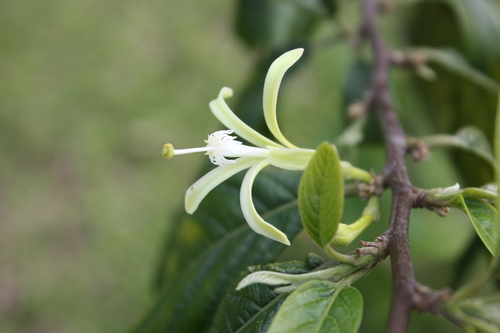
Wild Honeysuckle
Turraea floribunda
The Wild Honeysuckle is a sensory masterpiece of the forest, known for its intoxicating night-time fragrance and striking star-shaped fruits. This deciduous tree transforms from a bare silhouette into a bustling wildlife hub every spring.
Quick Identification
Size
A small to medium deciduous tree typically reaching 3–12 meters (10–40 feet) in height with a spreading canopy.
Colors
Pale green leaves; cream to greenish-white flowers that turn yellow with age; bright orange to reddish seed capsules.
Key Features
- Sweetly scented flowers with long, narrow petals that recurve backward
- Woody, star-shaped fruit capsules that split to reveal oily red seeds
- Smooth grey bark on younger branches, becoming rougher with age
- Deciduous leaves that are often velvety when young
When You’ll See Them
Behavior
The Wild Honeysuckle tree is best known for its explosive flowering display, which usually occurs in early spring when the tree is still leafless or just as new leaves begin to emerge. During this period, the tree becomes a hub of activity as it releases a powerful, sweet fragrance that is particularly intense during the evening and night hours. This scent is a biological signal designed to attract nocturnal pollinators, specifically hawk moths, which possess the long proboscises needed to reach the nectar deep within the flowers.
In the ecosystem, the Wild Honeysuckle acts as a vital food source. Once the flowers fade, they develop into woody capsules. When these capsules ripen and burst open, they reveal seeds coated in a bright, oily substance known as an aril. This attracts a wide variety of fruit-eating birds, such as turacos and bulbuls, who play a critical role in seed dispersal. Unlike invasive garden honeysuckles, Turraea floribunda is a structural component of forest edges and coastal bush, providing both nesting sites and seasonal forage.
EverydayEarth exclusive
Camera Tips
To capture the best footage of the Wild Honeysuckle, focus your camera on the branch tips where flower clusters or seed pods are most dense. Because this tree is a magnet for wildlife, the strategy differs depending on whether you want to film pollinators or seed-eaters. For the spectacular flowering phase, set your camera to a high-sensitivity night mode or use a gentle external IR light. Hawk moths are extremely fast, so if your camera allows for adjustable shutter speeds, aim for a faster setting to avoid motion blur when they hover near the blooms.
During the fruiting season, reposition your camera to overlook the open seed capsules. These bright orange seeds are irresistible to birds. Mount your camera on a nearby branch or a sturdy tripod at eye level with the fruit, roughly 3 to 5 feet away to ensure the birds remain in focus. Since birds like the Purple-crested Turaco or Black-eyed Bulbul are most active in the early morning, ensure your camera's 'wake-up' trigger is set to its most sensitive level to catch them as they land.
Time-lapse photography is another excellent way to showcase the Wild Honeysuckle. Setting a camera to take a photo every 30 minutes during the early spring can capture the dramatic transition from a bare-branched tree to one covered in white blossoms. For suburban gardeners, placing a camera near the base of the tree may also reveal small mammals, like duikers or rodents, who scavenge the oily seeds that fall to the ground.
Similar Species
Species that look similar or are commonly confused with Wild Honeysuckle.
Cape Honeysuckle
Unlike the Wild Honeysuckle tree, this is a scrambling shrub with trumpet-shaped orange flowers and dark green, serrated leaves.
Common Honeysuckle
This is a climbing vine (Lonicera) common in the Northern Hemisphere, whereas Turraea floribunda is a self-supporting tree native to Africa.
Frequently Asked Questions
Record Wild Honeysuckle at your habitat
Connect a camera to start building your own species record — AI identifies every visitor automatically.