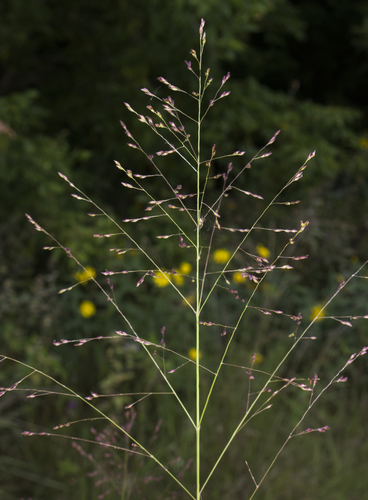
switchgrass
Panicum virgatum
A towering icon of the American prairie, switchgrass brings dramatic movement, golden autumn colors, and essential winter sanctuary to any backyard habitat.
Quick Identification
Size
3–8 feet (0.9–2.4 meters) tall; 2–3 feet (0.6–0.9 meters) wide
Colors
Bright green leaves in summer; airy reddish-purple seed heads; golden-yellow or burnt-orange foliage in fall; tan in winter.
Key Features
- Delicate, cloud-like seed panicles
- Upright, stiff stems that remain standing in winter
- Distinct patch of white hair where the leaf meets the stem
- Deep, fibrous root system reaching up to 10 feet
When You’ll See Them
Behavior
Switchgrass is a resilient, warm-season perennial bunchgrass that serves as a cornerstone of the North American prairie. Unlike cool-season grasses that peak in spring, switchgrass waits for the summer heat to truly thrive, exploding into growth when other plants begin to flag. It grows in tidy clumps that spread slowly via short underground rhizomes, making it much more well-behaved in a backyard setting than aggressive, running grasses.
In the wild and in the garden, switchgrass acts as a living structure. Its stiff, woody stems are remarkably wind-resistant, allowing it to provide architectural interest and wildlife shelter long after the first frost. For humans, it offers a visual barometer of the seasons, transitioning from a lush green screen to a shimmering fountain of seeds, and finally to a sturdy golden pillar that provides movement and sound as it rustles in the winter wind.
EverydayEarth exclusive
Camera Tips
When setting up an AI-powered camera to capture the life surrounding your switchgrass, positioning is everything. Because the grass can reach heights of 6 feet or more, place your camera on a mounting stake about 24 to 30 inches off the ground. Angle it slightly upward to capture the seed heads against the sky. This is where you'll see the most action; songbirds like goldfinches, dark-eyed juncos, and various sparrows love to perch on the flexible stems to feast on the protein-rich seeds during the late fall and winter months.
To avoid a memory card full of 'false triggers' caused by the grass waving in the wind, use your camera’s zone detection feature. Set the motion trigger zone to the base of the plant or a specific opening between clumps. This is a prime spot for capturing ground-dwelling wildlife like cottontail rabbits, ring-necked pheasants, or even the occasional fox using the dense stalks as a hunting blind. If your camera allows for sensitivity adjustments, set it to 'Medium' to ensure it picks up animal movement while ignoring the rhythmic swaying of the stalks in a light breeze.
Seasonal transitions offer the best filming opportunities. During the first heavy snowfall, keep your camera active. Switchgrass is one of the few native grasses that won't collapse under the weight of snow, creating 'thermal pockets' at its base. Small mammals and birds will congregate here for warmth and protection from predators. Setting your camera to 'Video Mode' with a 15-second duration will give you the best chance of seeing a bird landing on a seed head, swaying significantly, and then stabilizing itself—a classic backyard wildlife moment that is beautifully framed by the grass's delicate texture.
Similar Species
Species that look similar or are commonly confused with switchgrass.
Frequently Asked Questions
Record switchgrass at your habitat
Connect a camera to start building your own species record — AI identifies every visitor automatically.